
If you have ever wondered what your child actually does all day at a childcare center, you are not alone. Most parents want a clear picture of how the hours between drop-off and pick-up are spent. Here is a detailed look at what a typical day looks like, why structure matters, and how each part of the schedule supports healthy development across all age groups.
Key Takeaways
- A typical day at a childcare center follows a predictable daycare schedule from roughly 6:30 a.m. to 5:30–6:00 p.m., balancing learning, play, meals, and rest across a 10 to 11 hour window.
- Structured daily routines like morning arrival, circle time, outdoor play, and quiet time are adapted for different age groups, from infant care starting at six weeks through school-age programs for children up to 12 years old.
- Quality child care centers, such as Mary Margaret Daycare and Learning Center in the St. Louis area, design each segment of the day to support social, emotional, physical, and cognitive developmental needs.
- Family communication is woven throughout the day, with consistent safety practices and nurturing relationships at every stage.
- While every childcare provider is unique, most centers follow a similar flow: warm welcome, group activities, learning through play, healthy meals, physical activity, quiet time, and a calm transition home.
Why Structure Matters in a Typical Childcare Day
Predictable routines help young children feel secure and encourage healthy habits. When children know what comes next, whether it is breakfast, circle time, or outdoor play, they experience less anxiety during transitions and gain a growing sense of independence. A 2024 systematic review found strong links between consistent daily routines and improved cognitive ability, self-regulation, and social-emotional outcomes in early childhood.
Structured schedules help children feel safe and reduce stress, while daily routines promote social skills like cooperation and sharing. A balanced schedule supports whole-child development: group activities build social skills, physical activity supports health, and quiet time strengthens emotional regulation. Consistent routines also support emotional stability in children, which is critical given that 80% of brain development occurs in the first three years. Licensed child care centers must meet state licensing regulations for safety and supervision ratios, but daily schedules should remain flexible to accommodate children’s needs and interests.
Morning Arrival and Warm Welcome (6:30–9:00 a.m.)
Most centers open between 6:30 and 7:00 a.m. with a calm atmosphere: lights softened, gentle music, and small-group play options set out in classrooms. Caregivers create welcoming routines to support children during drop-off. Teachers greet each child by name, help with coats and backpacks, and briefly check in with parents about sleep, meals, and any special instructions.
Morning choices typically include quiet activities like blocks, books, dramatic play, or simple puzzles that let children ease in at their own pace. Staff use this moment to observe moods and health, and to make sure all arrivals are safely signed in. Routines help children transition smoothly from home to daycare, and transition periods require support to help children manage activities and routines. Care routines include arrival, meals, toileting, diapering, rest, and pickup, all woven seamlessly into the morning flow. Infant rooms may start with bottle feeding and cuddling, while older children might draw with friends or explore toys.
Circle Time and Group Activities
Circle time is a daily anchor where children gather with their teacher for songs, stories, and conversations. Typical elements include a greeting song, calendar and weather talk, simple counting, the letter or shape of the week, and a short read-aloud story.
Circle time activities help develop children’s listening skills, turn-taking, language, and early math and literacy, and they build a sense of classroom community. For toddlers, these experiences are brief and sensory-rich. For preschoolers and pre-K, they are longer and more interactive, with early academic games and discussions. Many centers use circle time to introduce daily themes like seasons, animals, or community helpers, and to preview the day’s group activities. A typical daycare day includes structured learning and creative play, and daily schedules often combine free choice play and guided group activities.
Learning Through Play and Age-Appropriate Centers
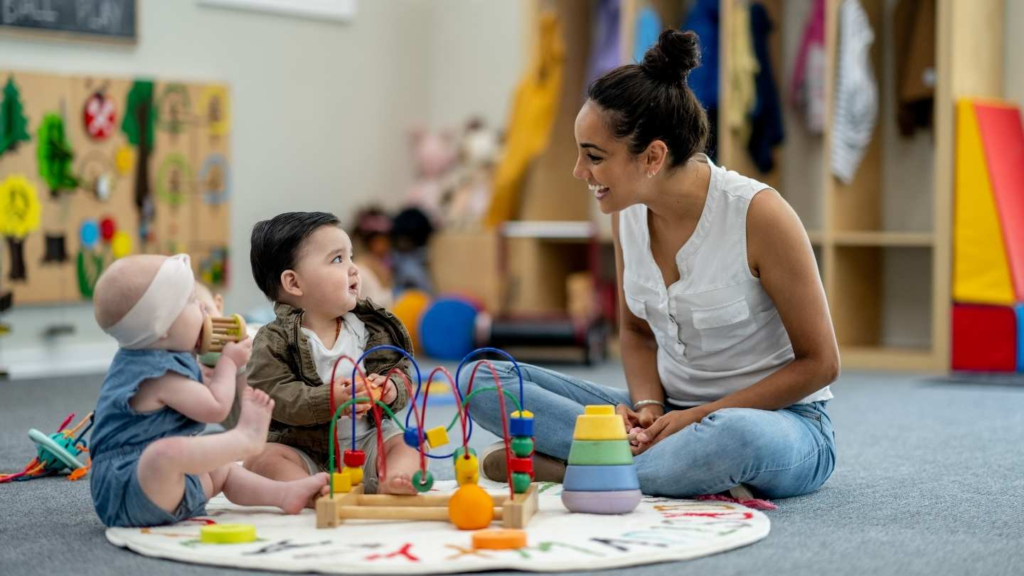
Much of the learning in a quality child care center happens through play in learning centers, not formal desk work. Common classroom centers include a block area, dramatic play corner, art table, science or nature center, literacy corner, and a fine-motor zone with items like beads, pegboards, or puzzles.
Teachers plan center activities that match developmental needs for various age groups. Infants explore soft blocks and stacking cups, while preschoolers build roads and bridges. Children’s activities include free-choice centers, sensory and discovery play, language, literacy, and physical activity. Educators move around the room asking questions, modeling language, and gently guiding play so children practice problem-solving, cooperation, and creativity. Caregivers provide a balanced mix of teacher-directed and child-chosen activities, managing continuous transitions while supervising play and facilitating learning. Meals and self-care routines provide meaningful learning moments rather than interruptions. Small-group art projects or simple science experiments often take place mid-morning before lunch.
Meals, Outdoor Play, and Physical Activity
Late morning and midday typically include a healthy snack, lunch, and at least one longer period of outdoor play or indoor gross-motor time. Snack and lunch follow a consistent routine: handwashing, sitting at child-sized tables, practicing manners, and trying a variety of nutritious foods. Snack time helps children practice social skills and independence.
Children typically engage in outdoor play for at least 60 minutes daily. Outdoor play is essential for building gross motor skills and burning off energy. Secure playgrounds offer age-appropriate equipment like climbers, slides, tricycles, and sand or water tables where children run, climb, and play games. Toddlers need at least 60 minutes of active play daily, while preschoolers require up to two hours of physical activity daily. Active play and coordination exercises are scheduled whether outside or in a gym space. Scheduling is coordinated among age groups so infants, toddlers, and preschoolers have separate or staggered outdoor playtimes for safety and appropriate supervision.
Quiet Time, Naps, and Afternoon Activities
After lunch, most child care centers move into a calm period of quiet time to allow children to rest and recharge. Daily schedules include quiet time or nap time for children of all ages. Younger children and toddlers typically nap on labeled cots or cribs in a dim room with soft music or white noise. Older preschoolers may rest briefly and then transition to quiet activities.
For non-sleepers, quiet time might include looking at books, drawing, simple puzzles, or listening to stories, all while maintaining a peaceful environment. An afternoon snack re-energizes children for the final stretch of the day. Later afternoon features lighter, creative activities: art projects, sensory bins, group games, or revisiting learning centers. Preschoolers benefit from longer blocks of learning and more planned small-group activities during this time. Staff also use this block for gentle transitions, including bathroom breaks, diapering, and tidying classrooms.
End of Day, Pick-Up, and Family Communication
From roughly 3:30 to 5:30 p.m., classrooms shift to calm group activities like board games, building, stories, or music so children remain engaged but not overstimulated. A typical daycare day lasts between six to ten hours, depending on the family’s schedule.
At pick-up, parents sign out and teachers share brief updates about the child’s day. Caregivers document meals, naps, diapering, incidents, and children’s development, and many centers use daily reports or apps to share photos, highlights, and reminders with families. Staff ensure each child leaves with personal items, artwork, and a sense of closure, often with a goodbye song or simple end-of-day ritual.
How a Typical Day Differs by Age Group
While the daily flow is similar across a center, each age group has its own rhythm and developmental focus.
- Infants (6 weeks–18 months): Infant rooms follow each child’s documented schedule for feeding and sleeping. Days include tummy time, soft music, sensory exploration, and one-on-one caregiver interaction. Four-month-olds can hold up their heads unsupported, and nine-month-olds start to crawl and show preferences for toys.
- Toddlers (18 months–3 years): Toddlers’ schedules include active play, short group activities, and substantial help with self-care like handwashing and toileting. Two-year-olds can speak in two to four-word sentences, and the focus is on language, independence, and cooperation.
- Preschool/Pre-K (3–5 years): Longer circle time, introduction of early literacy and math, and complex group projects prepare children for kindergarten. Three-year-olds can run, jump, and take turns in games, while five-year-olds can skip and tell stories with full sentences.
- School-age (up to 12 years): After-school programs include homework help, snack, outdoor play, and enrichment activities like STEM projects or art in a relaxed, age-appropriate group setting.
With 80% of brain development occurring in the first three years, the infant and toddler years carry enormous weight, and every part of the program is designed to support that progress.
Mary Margaret Daycare and Learning Center: Our Daily Approach
Since 1988, Mary Margaret Daycare and Learning Center has served families across nine locations in the St. Louis Metropolitan area, offering programs for ages six weeks to 12 years. Our typical day is built around four pillars: nurturing care, creative learning, whole-child development, and structured growth.
Each location follows a consistent core schedule, including arrival, circle time, group activities, outdoor play, nutritious meals, quiet time, and family communication, but adapts it to its classrooms, facility layout, and enrolled age groups. We also offer before and after school care and fun-filled summer programs with field trips woven into the daily rhythm. To explore our programs or schedule a tour, visit us online and see a typical day in person.
Frequently Asked Questions
How long is a typical day at a child care center?
Many child care centers are open roughly 10–11 hours a day, for example 6:30 a.m. to 5:30 p.m., to support working families. Individual attendance may be shorter depending on parents’ schedules. Mary Margaret’s exact hours vary by location, so check the specific center you are interested in for opening and closing times.
What should I expect my child to learn during a typical day?
Children build early childhood education skills like letters, numbers, colors, and shapes through circle time, stories, and playful group activities rather than formal lessons. Social skills, emotional regulation, independence, and problem-solving are equally important learning goals woven into daily routines and playtime.
How do child care centers handle different developmental needs within the same classroom?
Teachers plan activities with varying levels of difficulty and give children choices so each child can participate at their own abilities. Staff observe children daily, adjust expectations, and communicate with families if additional support or enrichment resources may be helpful.
What if my child has trouble at drop-off or during quiet time?
Teachers use strategies like comfort items from home, consistent goodbye routines, and quick, calm transitions to help children separate smoothly. During nap time, children who do not sleep are offered quiet alternatives like books or drawing, which reduces stress while still respecting classmates’ need for rest.
How can I see what my child’s typical day looks like before enrolling?
The best way is to visit and search for a center near you. Schedule an in-person tour to observe classrooms, talk with teachers and providers, and review the written daily schedule posted in rooms. We invite you to schedule a tour at a Mary Margaret Daycare and Learning Center location in the St. Louis Metropolitan area to experience our approach firsthand.