Key Takeaways
- Daily art activities in early childhood help build language, motor, social-emotional, and early academic skills all at once, making them far more than “just for fun.”
- Simple, hands-on projects like drawing, painting, collage, clay, music, and movement are powerful tools for supporting the whole child across every developmental domain.
- Quality early childhood centers, like Mary Margaret Daycare and Learning Center in the St. Louis area, intentionally weave art into everyday childcare routines for children from six weeks through 12 years old.
- Families searching for childcare should look for a learning center that treats art as a core part of the curriculum and invites parents to see and celebrate their child’s creative work.
- Art activities can help parents decide whether a program is the right fit for their child’s personality, learning style, and interest in exploration.
Introduction: Why Art Matters in Early Childhood
From birth through age five, a child’s brain is developing at a staggering pace. Over 1 million new neural connections form every second in early childhood, and creative art play is one of the richest ways to support that growth. Art activities play a foundational role in early childhood development, touching everything from how babies explore textures to how preschoolers tell stories through paint and paper.
When we say “art activities,” we mean drawing, painting, collaging, cutting, music, dance, dramatic play, and simple crafts. These can happen at home and in an early childhood center. High-quality childcare programs use art to nurture the whole child: social, emotional, physical, and cognitive development woven together. Children ages 6 weeks to 5 years benefit from structured early education that includes daily creative experiences.
At Mary Margaret Daycare and Learning Center, art has been a daily part of how we blend fun with education across our nine St. Louis locations since 1988. In this article, we walk through specific developmental benefits, age-appropriate projects, and what families should look for when choosing a learning center.
How Art Supports the Whole Child
The term “whole child” means looking beyond academics to include social skills, emotional health, physical growth, and cognitive development as equally important. Engaging in art is a multi-sensory experience that naturally touches every one of these areas at once.
- Social-emotional growth: Art lets children express feelings, experiment safely, and build confidence when teachers notice and display their work.
- Cognitive development: Art activities promote cognitive development in children. Planning a picture, choosing colors, and figuring out how to attach pieces in a collage all build early problem-solving. Art encourages problem-solving and critical thinking in ways that feel like play.
- Physical development: Fine motor skills develop through grasping crayons and squeezing glue, while gross motor skills grow through big brush strokes, dancing, and movement to music.
- Language and communication: Children learn new words for colors, shapes, textures, and feelings as they talk with teachers about what they are creating.
Play-based learning supports social, emotional, and academic growth simultaneously. A creative curriculum enhances classroom quality and promotes school readiness by building attention span, persistence, and flexible thinking through ongoing art experiences. Research shows that structured arts programs produce moderate effect sizes (Hedges’ g of 0.42 to 0.60) for executive function skills like working memory and cognitive flexibility in young children.
Creative Expression and Emotional Development
Young children often express big feelings more easily through art than through words, especially during the toddler and preschool years. Art provides a non-verbal outlet for processing complex feelings like frustration, excitement, jealousy, or pride.
Open-ended art with no “right answer” lets kids explore emotions in a safe, non-judgmental way. Art activities provide a safe outlet for emotional expression, and art activities support emotional expression in young children who may not yet have the vocabulary for what they feel. Choosing colors and testing designs fosters creative discovery while promoting self-regulation and patience.
Concrete activity examples include:
- Feeling-themed drawing stations
- “Mood color” painting where kids pick colors that match how they feel
- Creating family portraits or comfort objects from clay and playdough
Teachers at a high-quality early childhood center respond by labeling feelings: “You chose a lot of dark colors-are you feeling frustrated today?” This validates the child’s experience in a nurturing environment. Creative Curriculum promotes social-emotional growth in children by building these intentional responses into daily routines.
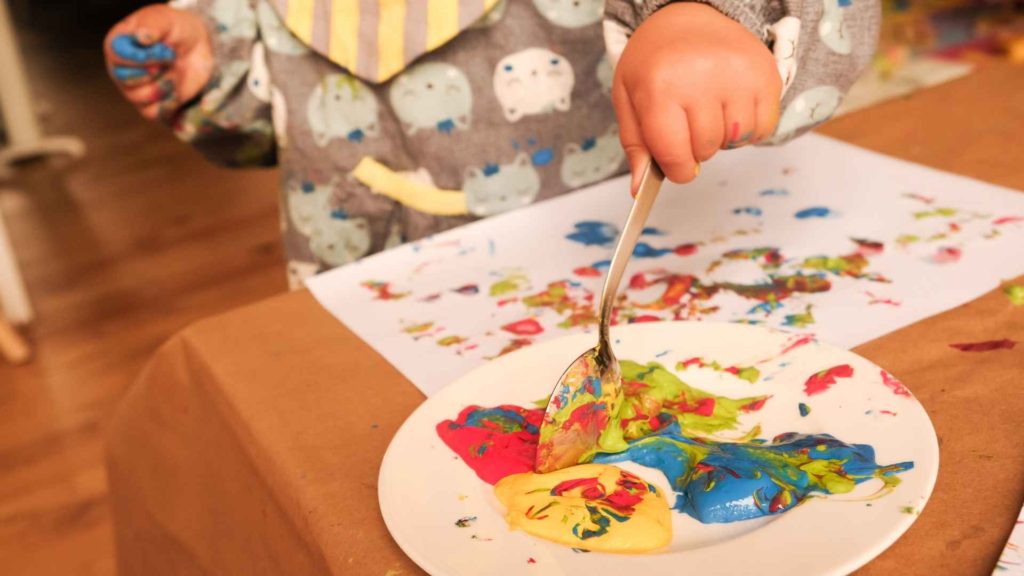
For babies and toddlers (around 6 weeks to 24 months), sensory art like finger painting with edible paints and exploring soft brushes sets the foundation for later self-expression. Emphasizing process art maximizes developmental benefits in children at every age. Regularly displaying artwork in hallways and classrooms boosts self-esteem and gives families natural starting points to talk with kiddos about their day.
Fine-Motor Skills and Brain Development
Art activities are a fun workout for small muscles in the hands and fingers-muscles that later support writing, self-feeding, and self-care tasks like buttoning a coat. Art activities strengthen fine motor skills necessary for writing, and creative activities help develop fine motor skills in preschoolers through repeated, enjoyable practice.
Specific art actions that build strength and coordination include:
- Scribbling with chunky crayons
- Painting with thick-handled brushes
- Threading large beads
- Tearing and gluing paper
- Using child-safe scissors
Art activities enhance hand-eye coordination and spatial awareness as children learn to control their movements. Experimentation with materials teaches cause-and-effect relationships-press harder with a crayon and the line gets darker; squeeze the glue bottle and it flows out. Children form over 1 million neural connections every second, and these repeated art actions help strengthen neural pathways for focus, coordination, and later handwriting.
A recent experimental study in Bangkok with 3- to 4-year-olds found that mixed media art activities four times per week over six weeks produced statistically significant improvements in fine motor skills. Art activities enhance sensory exploration and physical development in ways that carry over into every part of a child’s life. At Mary Margaret Daycare and Learning Center, teachers intentionally set out materials that match each age group’s abilities, from babies in high chairs exploring safe textures to school-age children designing detailed projects.
Art as a Bridge to Early Literacy and Math
Art in early childhood doesn’t replace academic learning-it prepares children for it by building pre-literacy and early math skills in low-pressure, playful ways. Art supports school readiness and lifelong learning preparation because children learn through hands-on activities and exploration.
Literacy connections:
- Art encourages narrative skills and storytelling development when children draw scenes and explain them
- Describing artwork expands children’s vocabulary with words for colors, shapes, and emotions
- Art is essential for language and communication development, especially through class books and murals tied to read-aloud stories
Math connections:
- Sorting colored papers, counting stickers, and making patterns with stamps
- Noticing shapes in drawings and comparing sizes while collaging
In a typical day at a learning center, a preschool art center might have children creating pattern crowns or working on a letter-of-the-week art project. Teachers use casual questions during art time-“How many dots did you add?” or “Which line is longer?”-to introduce math vocabulary naturally. Play-based learning fosters curiosity and a love of learning, and even when it looks like “just coloring,” carefully planned art activities are building school readiness in a developmentally appropriate way.
Social Skills, Collaboration, and Classroom Community
Group art projects help young children learn to work with others, share materials, and feel part of a classroom community. Art promotes social development through collaborative projects, and group art projects develop empathy and cooperation skills that carry into every area of life.
Cooperative activities include class murals, seasonal hallway displays, group collages using materials from a nature walk, or simple performances combining art, music, and movement. Teachers scaffold turn-taking and polite language during art time: “May I have the glue when you’re finished?”
Art can be especially helpful for children who are shy, new to the early childhood center, or still building English language skills-they can participate without needing a lot of words. Children learn to appreciate different perspectives through art, and art activities expose children to diverse cultures and traditions through projects that reflect the community.
Programs support social, emotional, and academic growth for children, and social-emotional screenings are conducted using ASQ: SE assessments to track each child’s progress. At Mary Margaret Daycare and Learning Center, classrooms celebrate completed projects with family events and hallway “galleries” that spark conversation. These experiences help children feel that the learning center is the right fit-their ideas are involved and they belong.
Art Experiences Across Ages: From Infants to School-Age
Art should look different at each developmental stage. Here is how expectations and materials change from early head start ages through school-age care:
| Age Group | Focus | Materials & Activities |
| Infants (6 weeks–12 mo) | Sensory exploration | Soft brushes, high-contrast images, teacher-supported handprint keepsakes |
| Toddlers (1–3 years) | Process-focused, messy play | Finger painting, dot markers, large crayons, chunky stamps, simple collages |
| Preschool (3–5 years) | Intentional, multi-step projects | Theme-based work (seasons, community helpers), art combined with literacy and math |
| School-age (5–12 years) | Complex, collaborative projects | Drawing from observation, simple sewing, building models, after-school creative time |
Children engage in art to enhance their creativity at every age. Art fosters problem-solving skills through creative exploration, whether a toddler discovers what happens when two paint colors mix or a school-age child plans a detailed model. At Mary Margaret Daycare and Learning Center, each classroom has access to age-appropriate art materials every day-not just for holidays-so children can create regularly as part of their daily routines and schedule.
What Families Should Look For in an Early Childhood Center’s Art Program
If you are a parent touring programs and trying to find child care that fits your family, pay attention to the art environment. Here are signs of a strong art program:
- Daily access to open-ended materials
- Children’s work displayed at eye level, with projects that look different from child to child
- Teachers who talk with kids about their choices rather than directing every step
- A culture where children are encouraged to get a little messy, try again, and make their own decisions
Questions to ask on a tour: “How often do children do art?” “Do you focus more on the process or the final product?” “How do you adapt art activities for different ages?” Also ask about developmental screenings and whether the program holds Missouri Accreditation, which recognizes programs meeting high quality standards.
Art activities help build confidence and self-esteem in children, and research shows that high-quality early childhood programs can yield a 13% annual return on investment through improved outcomes. When art is thoughtfully planned and supported, it becomes a clear indicator that a center values creativity, confidence, and joy in learning.
How Mary Margaret Daycare and Learning Center Uses Art Every Day
Since 1988, our St. Louis childcare centers have balanced fun with structured learning, with art playing a central role. Each of our nine locations across the St. Louis Metropolitan area-serving families from Louis, MO and surrounding communities-offers daily art opportunities as part of our programs for children from six weeks to twelve years old.
Creative learning is built into our routines: morning art centers, themed projects connected to weekly topics, and flexible art time in before and after school programs and summer camps with field trips. Our approach connects directly to our core pillars:
- Nurturing Care: Children feel warm, safe, and loving support to try new ideas
- Creative Learning: Hands-on exploration with varied materials builds curiosity
- Whole-Child Development: Social, emotional, physical, and academic skills grow together
- Structured Growth: Consistent routines with room for imagination and expertise
Concrete examples include summer mural projects inspired by local St. Louis landmarks, fall leaf rubbings collected on playground walks, and literacy-linked art tied to books from circle time. A creative curriculum enhances classroom quality and promotes school readiness across every classroom.
We invite families to learn more about our programs and schedule a tour to see art in action. Our mission is to deliver experiences where every child can spend time creating, connect with members of their classroom community, and build confidence alongside a lifelong love of learning. We strive to be the secure, nurturing place where your daughter or son thrives-and enrollment is open at all locations.
FAQ: Art Activities and Early Childhood Development
Below are answers to common questions from parents about art and early childhood.
How often should my young child be doing art activities?
In early childhood, brief daily opportunities are ideal. Even 10–15 minutes of drawing, painting, or sensory play at home makes a difference, and a high-quality early childhood program should offer daily art centers. Consistency matters more than duration-children benefit most when art is a regular part of their week, not a once-in-a-while event.
What if my child doesn’t seem interested in drawing or crafts?
Try different types of art: music, dance, building with blocks, sensory bins, or chalk outside. Interest often grows when kids feel no pressure and have real choices. Not every child gravitates toward crayons, and that is completely normal. The goal is to promote exploration, not perfection.
Do art activities always have to be messy?
Not at all. Stickers, crayons, collage with pre-cut shapes, and water painting outside are low-mess options. That said, some supervised messy play-like finger painting or clay-is valuable for sensory development and should be part of the mix.
How can I support my child’s art development if I’m not “artistic” myself?
Your role is to provide simple materials, time, and encouragement. Ask open-ended questions like “Tell me about your picture” instead of judging the artwork. Creativity is about the process, not the product, and your child does not need a parent with expertise in art to thrive.
What makes Mary Margaret Daycare and Learning Center’s approach to art different?
We treat art as a daily, intentional part of childcare-supporting the whole child-rather than an occasional extra. We utilize art across every age group, from babies through school-age kids, and we connect creative activities to our broader early childhood education goals. Parents in the St. Louis area are encouraged to visit one of our nine locations and search for the right fit by scheduling a tour to see art and learning in action.