Key Takeaways
Music and movement are not “extras” squeezed in between real lessons. They are essential pillars of early childhood education, shaping brain wiring, motor skills, language, and social-emotional growth from birth through age 5. Incorporating music and movement activities can support children’s development across cognitive, physical, social-emotional, and language areas, making them some of the most effective tools available to educators and parents alike.
Even very young infants benefit from gentle musical exposure and age-appropriate movement. Babies as young as six weeks old respond to soft singing, rocking, and rhythmic patterns. These early experiences build foundations for later reading, math, attention, and self-regulation. Children exposed to music have better language skills, and movement activities support cognitive flexibility and problem-solving skills well into the school years.
Music and movement activities can be woven into daily childcare routines, morning greetings, clean-up transitions, and quiet-time wind-downs, without expensive instruments or a large gym. The cognitive benefits (memory, problem-solving, language), social benefits (turn-taking, cooperation, empathy), and physical development gains (motor skills, coordination, balance) all come from consistent, playful practice rather than elaborate programming.
At Mary Margaret Childcare and Learning Center, music and movement are built into daily schedules across all nine St. Louis-area locations, supporting whole-child development for children enrolled from six weeks through twelve years old.
Why Music and Movement Matter in Early Childhood Education
Early childhood, birth to age five, is a period of extraordinary brain development. During these years, experiences literally shape which neural connections grow stronger and which fade away. Every song a child hears, every beat they clap, and every dance they attempt is feeding that rapid construction process. This is why what happens in a child care facility during these formative years carries so much weight.
Music and movement create what researchers call “multi-sensory learning.” When a toddler marches to a drumbeat, their brain is processing sound, coordinating muscles, tracking spatial position, and predicting what comes next, all at once. This kind of simultaneous engagement of hearing, sight, touch, balance, and body awareness strengthens cognitive development and memory far more effectively than passive instruction. Physical activity activates the brain more than sedentary tasks, which is exactly why movement-rich learning environments outperform worksheet-heavy ones for young children.
In early childhood education settings like childcare centers, preschools, and infant-toddler classrooms, music and movement are powerful tools educators can use every day. Research since the early 2000s consistently shows that children who participate in structured music or movement activities demonstrate stronger attention and language skills. A growing body of studies, including work published as recently as 2025 and 2026, confirms that these benefits extend to executive function, emotional regulation, and social cooperation.
In the sections ahead, we will cover how music and movement support cognitive development, language development, physical development, social skills, and emotional development. You will also find practical activity ideas organized by age group and specific ways to weave these experiences into daily childcare routines.
How the Young Brain Responds to Music and Movement
Between birth and roughly age three, the brain forms more than a million new synaptic connections per second. This explosive growth means that enriched environments, ones filled with varied sounds, rhythmic patterns, and opportunities to move, help organize these neural networks into efficient pathways. The brain’s neuroplasticity, its ability to reshape itself in response to experience, is at its peak during early childhood, making this window uniquely powerful.
Rhythm, beat, and patterned movement teach children’s brains to predict, sequence, and organize information. When a child hears a familiar song, their brain anticipates the next note or word before it arrives. This predictive processing is the same skill children later use for reading (anticipating the next word in a sentence), math (recognizing numerical patterns), and problem-solving (planning a sequence of steps). Sensory integration, the brain’s process of combining input from hearing, movement, touch, and vision, gets a full workout every time a child moves to music.
Consider a toddler clapping along to a steady beat. In that single activity, the child is practicing timing and rhythm (auditory cortex), coordinating hand movements (motor cortex), listening and waiting for the right moment (prefrontal cortex for attention and inhibition), and, if they are in a group, watching peers and taking turns (social cognition). Research with infants as young as three months old shows enhanced neural responses to structured music compared to scrambled sound, confirming that even babies at a very young age are wired to process musical patterns. By 12 months, more organized movement responses, bouncing, swaying, swinging, begin to emerge in response to rhythm, demonstrating that the brain-body connection is strengthening rapidly.
Music and Cognitive Development in Early Childhood
Cognitive development encompasses thinking, memory, attention, problem-solving, and the early executive function skills that prepare children for school. Music activities enhance children’s memory retention and recall because songs naturally embed information in patterns the brain finds easy to store and retrieve.
Songs with repetition and predictable structures (think “Old MacDonald” or “Itsy Bitsy Spider”) strengthen memory and sequencing as children anticipate what comes next. A child singing along knows that after “E-I-E-I-O” comes the animal sound, and that rehearsal of sequence builds working memory. Studies show that preschoolers taught new vocabulary through songs developed deeper word knowledge than children taught with picture cards alone, suggesting that musical context gives the brain extra hooks for storing information.
Keeping a beat, copying clapping patterns, or following musical directions all support attention control and working memory – core cognitive benefits linked to school readiness. Movement activities support cognitive flexibility and problem-solving skills because they require children to adapt quickly to changing instructions. Experiential learning through movement enhances understanding of concepts in ways that sitting still simply cannot replicate.
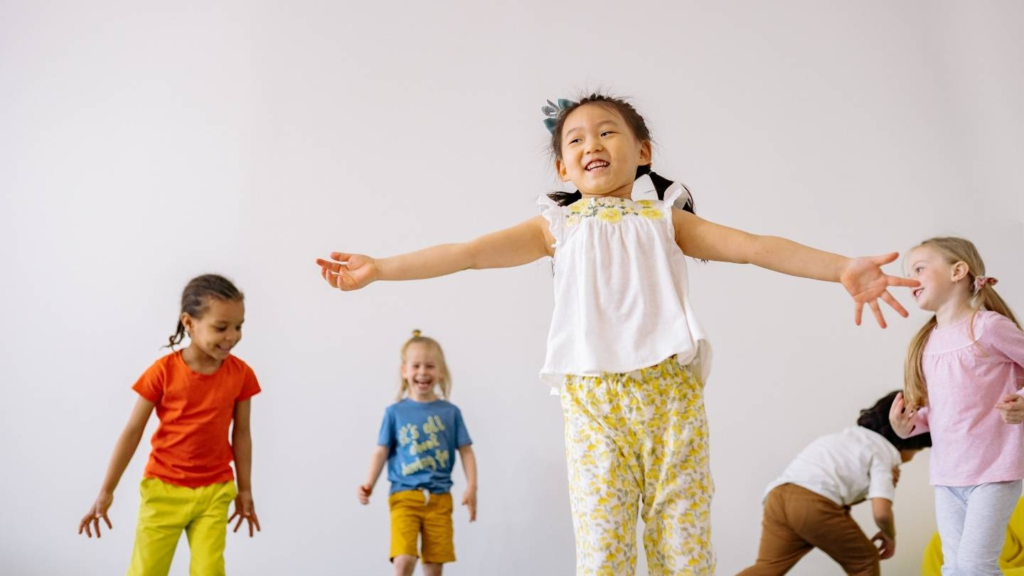
Here is a concrete classroom example: a group of 3- and 4-year-olds playing “freeze dance.” The music plays, everyone dances freely. When the music stops, everyone freezes. This simple game practices listening, impulse control, and quick decision-making, all executive function skills, packaged in pure fun. A Greek study with 5- and 6-year-olds found that just five minutes of music-and-movement breaks significantly improved inhibitory control compared to a sedentary control group. Across early childhood education research, children who regularly engage in purposeful music and movement activities show improved focus, early math skills (patterns, counting beats), and flexible thinking.
Language Development Through Song, Rhythm, and Movement
Language development in early childhood includes vocabulary growth, understanding and using sentences, and prosody, the rhythm and melody of speech itself. Singing is one of the most natural and effective ways to build all three, which is why children exposed to music have better language skills overall.
Singing nursery rhymes and fingerplays like “Twinkle, Twinkle, Little Star” and “Head, Shoulders, Knees and Toes” exposes children to rich vocabulary, rhyme, and sentence patterns. Rhyme awareness – noticing that “star” and “are” sound alike – is a building block of phonological awareness, which is one of the strongest predictors of later reading success. Infants whose mothers sing to them regularly show stronger neural tracking of rhythm, and those same infants tend to have larger vocabularies by 20 months.
Attaching movement to words deepens language development even further. When toddlers point to body parts during a song, act out verbs like “jump,” “tiptoe,” or “crawl,” or wave scarves high and low, they are mapping spoken language to real actions and objects. This embodied learning helps children understand words at a deeper level than hearing alone. In multilingual homes, home music activities correlate with stronger English vocabulary and pragmatic skills, helping bridge language exposure gaps.
Call-and-response songs (“Who stole the cookie from the cookie jar?”) help children practice conversational turn-taking and listening, which are critical in group childcare settings. Here are a few quick examples by age group:
- Infants: Caregivers singing slow lullabies during feeding, pausing to let the baby vocalize back.
- Toddlers: Action songs like “If You’re Happy and You Know It” that pair words with claps, stomps, and cheers.
- Preschoolers: Story-songs like “Going on a Bear Hunt” where children narrate, chant, and move through an imaginary adventure.
Physical Development: Building Motor Skills Through Movement
Physical development in early childhood includes both gross motor skills, running, jumping, balancing, climbing and fine motor skills like finger control, grasping small objects, and clapping precisely. These skills do not appear automatically. They need daily practice through crawling games, dancing, jumping, spinning, and simple instrument play in early childhood education settings. Movement experiences refine children’s motor skills and expand movement vocabularies, giving them a wider repertoire of physical actions they can perform with confidence.
The numbers around children’s physical activity are concerning. Children ages 2 to 5 spend about 25 hours watching TV weekly. Preschoolers engage in moderate to vigorous physical activity only 3.4% of the day. Children under 7 expend 20 to 30 percent less energy than recommended levels. These trends, which have accelerated since about 2010 with rising screen time, contribute directly to health risks: 40 percent of children aged 5 to 8 already show at least one heart disease risk factor, and regular physical activity reduces children’s risk of obesity and heart disease. Movement-rich childcare environments serve as a protective factor against these trends, and regular physical activity sets the stage for lifelong fitness habits.
Music and movement enhance gross and fine motor skills simultaneously. Dancing, marching, clapping, and jumping develop balance, coordination, body awareness, and control of movements. Consider these specific activities:
- Marching to a drum: Builds leg strength, rhythm awareness, and bilateral coordination.
- Scarf dancing: Encourages full-body movement, spatial awareness, and creativity.
- Animal walks to a song: Bear crawls, frog jumps, and crab walks build strength across major muscle groups.
- Shakers and rhythm sticks: Strengthen the small hand and finger muscles needed later for writing, buttoning, and using scissors.
A two-month experimental music-and-movement program with preschoolers aged 4 to 6 produced significant improvements in jumping performance and dynamic balance compared to a traditional PE control group. These results confirm that structured, playful movement – not rigid drills – is what most children need to build strong, capable bodies.
Social Skills and Social Benefits of Group Music and Movement
Social skills, sharing, turn-taking, cooperation, and empathy, often grow faster in environments with frequent group interaction, which is exactly what a child care center provides. Group music activities enhance children’s social skills because they require everyone to participate, listen, and respond to one another in real time.
Circle-time songs, partner dances, and movement games naturally require children to watch peers, wait their turn, and cooperate. A 2026 quasi-experimental study found that structured music interventions in preschool classrooms improved prosocial behavior, cooperation, and emotion regulation, with synchrony (moving together) and turn-taking identified as the key mechanisms driving those gains. Children learn cooperation through music and movement activities because the activities themselves demand it you cannot play a call-and-response game alone.
Picture a preschool class passing a drum around the circle. Each child gets a turn to play a short pattern while the others listen and encourage. This simple activity practices patience, active listening, and positive peer interaction. Performing music in front of the group, even something as small as shaking a maraca during a song, boosts children’s confidence and self-esteem.
Multi-age group experiences, common in family childcare homes and after-school programs, allow younger children to learn movement games from other children who are older, supporting social learning and leadership. Music and movement can be especially helpful for children who are shy or still developing verbal language, giving them a nonverbal way to join the group and feel included without needing perfect words.
Emotional Development and Self-Regulation Through Music and Movement
Emotional development means recognizing, expressing, and managing feelings, and beginning to calm oneself with support from caregivers. From the earliest weeks of life, music plays a crucial role in helping children feel emotionally secure. Music provides a safe outlet for children to express and process complex emotions, and music fosters emotional expression in children who may not yet have the words to say “I’m frustrated” or “I’m scared.”
Gentle songs, rocking, and predictable musical routines help infants and toddlers feel safe and soothed. A lullaby sung in a consistent, calm voice signals to a baby’s nervous system that everything is okay, which is essential for healthy emotional development. Music and movement strengthen bonds between children and caregivers through these shared, intimate moments.
Educators and parents can use movement to “match and then change” a child’s mood. If a child is bursting with energy or frustration, start with an upbeat song and big movements to channel that intensity. Then gradually shift to a slower song and gentle stretching to calm down. This approach teaches children, emotionally and physically, that intense feelings can be managed and will pass.
Simple breathing and movement routines work well for preschoolers: “smell the flower” (deep inhale with arms rising) and “blow out the candle” (slow exhale with arms lowering). These techniques build self-regulation starting around age 3. Creativity and self-expression are enhanced through music and movement activities in early childhood education because children often express emotions more freely through dancing, drumming, and dramatic movement than through words alone.
Music and Movement for Infants (6 Weeks to 18 Months)
Even babies in childcare from about six weeks benefit from soft singing, gentle rocking, and simple rhythmic patterns. These earliest musical experiences support bonding, early brain development, and the infant’s growing sense of safety in their environment.
Appropriate activities for this age group include caregivers singing during feeding and diaper changes, slow swaying with a baby in their arms, tummy time with soft background lullabies, and simple fingerplays like “This Little Piggy” for older infants. Research shows that 7-month-olds demonstrate stronger neural tracking during lullabies, and that “playsongs” with more rhythmic energy elicit more movement responses – both linked to later vocabulary development.
Adults should move slowly, make warm eye contact, and use calm, reassuring voices. Infants respond not only to sound but also to the caregiver’s facial expressions and touch. Safety and responsiveness matter most: avoid loud or startling music, and allow babies to turn away or rest when they have had enough stimulation. Infant rooms can schedule short, frequent music-and-movement moments throughout the day – a soft song during each diaper change, gentle bouncing during play – rather than formal “lessons.”
Music and Movement for Toddlers (18 Months to 3 Years)
Toddlers are energetic explorers who use movement to test boundaries, understand space, and practice independence. This makes the toddler years a prime time to integrate music and movement into early childhood education. Most children at this young age want to be active, and channeling that energy through musical play is far more effective than trying to contain it.
Age-appropriate activities include simple action songs like “If You’re Happy and You Know It,” instrument exploration with shakers and drums, copy-my-move games where an adult performs a motion and children imitate, and short movement stories like “We’re Going on a Bear Hunt.” These activities sharpen motor skills, build new words, and improve attention spans while matching toddlers’ need for frequent transitions and active play.
Toddlers experience huge growth in both cognitive development and emotional development, so childcare professionals can use musical cues for routines – a “clean-up song,” a “nap-time lullaby” – to make transitions smoother and more predictable. A study of 106 toddlers found that home music activities correlated positively with vocabulary and pragmatic language outcomes, especially for children from multilingual households.
The importance of repetition for this age group cannot be overstated. Toddlers often want the same song or game over and over, and that repetition is not a sign of boredom – it is how they learn and find comfort.
Music and Movement for Preschoolers (3 to 5 Years)
Preschoolers are ready for more structured musical and movement experiences that connect directly to early childhood education goals like pre-literacy, numeracy, and social skills. At this age, children can follow multi-step directions, participate in group choreography, and even begin to create their own musical ideas.
Activities that work well include rhythmic clapping patterns (clap-clap-pause, clap-clap-clap-pause), simple folk dances and circle games, marching bands with homemade instruments, and acting out stories or science concepts through movement. Teachers can link songs and movement to curriculum topics, a weather song with rain-tapping fingers and wind-swirling arms, or counting jumps and steps to support early math.
At this age, children can help create their own verses and movement ideas, which encourages creativity, confidence, and higher-order thinking. A child who invents a new animal verse for “Old MacDonald” is practicing vocabulary, imagination, and narrative structure all at once.
Here are two sample mini-lessons that integrate music and movement with academic objectives:
Literacy mini-lesson: Teach a rhyming song like “Down by the Bay.” After singing, ask children to invent silly rhymes (“Did you ever see a bear combing his hair?”). Add a movement for each rhyme – children jump for every rhyming pair they identify. This builds phonological awareness and gross motor skills simultaneously.
Math mini-lesson: Play “Rhythm Patterns.” Clap a simple pattern (one-two, one-two). Children echo it. Gradually increase complexity (one-two-three, one-two-three). Count the beats together. Then have children march the pattern across the room – one step per beat. This connects counting, pattern recognition, and physical activity into a single experience.
Integrating Music and Movement Into Daily Childcare Routines
This section is your practical toolbox. Music and movement do not need a dedicated time block to be effective. The best results come from weaving them into everyday tasks and transitions throughout the day.
Here are specific examples any center can use:
- Morning greeting song: A short welcome song that includes each child’s name, helping children feel recognized and building community.
- Line-up chant: A rhythmic chant before going outside (“One, two, buckle my shoe”) that turns waiting into learning.
- Clean-up song: A familiar tune that signals transition and gives children a predictable structure for tidying up.
- Quiet stretching before nap: Slow, gentle movements paired with soft humming to help children wind down.
- Goodbye song at pick-up: A consistent closing ritual that prepares children emotionally for the transition home.
These routines support cognitive development (sequencing, memory), social skills (group cooperation), and emotional development (predictability and security). They turn everyday tasks into learning moments without adding a single minute to the schedule.
Encourage teachers to use a mix of recorded music and live singing. Children do not need perfection – hearing their trusted adults sing, even off-key, is what matters. The emotional connection of a familiar voice carries more developmental weight than a polished recording.
Creating Movement-Rich, Music-Friendly Classroom Environments
A movement-rich classroom does not require a gymnasium. It requires intention. Open floor space where children can safely crawl, roll, and dance without bumping into furniture is the foundation. Soft mats for younger children, and a clear area free of obstacles for active movement, are essentials.
Simple, low-cost music materials make a big difference:
- Scarves and ribbons for flowing dance movements
- Homemade shakers (dry rice in sealed plastic containers)
- Rhythm sticks (wooden dowels cut to child-safe lengths)
- A small basket of soft hand drums
Store these in accessible baskets so children can explore instruments during free play, not just during structured music time. Educators support children’s exploration of musical interests freely when materials are available and inviting.
For safety and inclusion, ensure enough room between children during active movement, keep volume at comfortable levels for sensitive ears, and offer other ways to participate, tapping knees instead of jumping, swaying instead of spinning, for children with different abilities. In infant and toddler rooms, prioritize frequent floor time and free movement. Avoid overuse of restrictive devices like swings and bouncer seats that limit a child’s natural drive to move.
Picture a cozy corner with soft lighting for lullabies and story songs, and a bright open area with a smooth floor for active dance. That contrast gives children choices and teaches them to match their energy to the space, a self-regulation skill in itself.
The Role of Educators in Leading Music and Movement
Here is the most important thing to know: educators do not need to be professional musicians or dancers. Enthusiasm, consistency, and responsiveness to children are far more important than a “perfect” voice. If you can hum, clap, and move, you can lead effective music and movement experiences.
The educator’s role is to model participation, show genuine joy, and adapt activities for different ages and abilities. When a teacher dances with abandon during a movement song, children receive permission to do the same. When a teacher slows down and whispers a lullaby, children learn that gentle moments matter too. Educators create a musical environment in classrooms by making music a natural, daily presence rather than a special event.
Educators balance structured and unstructured activities for children – some moments are teacher-led sing-alongs, while others are open-ended exploration with instruments. During both, teachers can observe children closely, taking note of motor skills, language use, social interactions, and emotional responses to inform individualized support. A child who consistently avoids group dance but happily taps a drum alone might need a gentler entry point into group participation.
Continuing professional development equips educators with the necessary skills to lead music and movement confidently. Even a short workshop on leading circle-time songs or using rhythm instruments can transform a hesitant teacher into an enthusiastic one. Educators can also collaborate with families by sharing favorite classroom songs or movement games that parents can repeat at home, strengthening home-school connections.
Partnering With Families to Extend Music and Movement at Home
Child development is strongest when early childhood education programs and families reinforce each other’s efforts. This is especially true for language development and emotional development, where consistency across settings accelerates growth.
Centers can share ideas in simple, accessible ways: send home printed song lyrics in weekly folders, create short movement-game handouts, or include music-and-movement suggestions in monthly newsletters. Even a one-page “Song of the Month” sheet gives parents a concrete connection to what their child is doing at childcare.
Home-friendly activities require no special equipment:
- Dancing in the living room to a favorite song
- Singing during bath time
- Clapping games in the car
- Bedtime lullabies with gentle rocking
For parents concerned about time, suggest five- to ten-minute micro-routines – a morning “stretch and sing” before leaving for childcare, or a silly dance party while dinner is cooking. Even brief, everyday musical moments provide powerful cognitive and social benefits. The tone here is not “you should be doing more.” It is “what you are already doing counts, and here are a few more ideas to try.”
How Mary Margaret Childcare and Learning Center Uses Music and Movement
Mary Margaret Childcare and Learning Center has been a trusted early childhood education provider in the St. Louis Metropolitan area since 1988, serving children from six weeks to twelve years old across nine locations. From the beginning, the center’s philosophy has emphasized that fun and education go hand in hand and music and movement are at the heart of that balance.
Music and movement are woven into daily schedules at every level. In infant rooms, caregivers sing gentle lullabies during feeding and rocking. Toddler and preschool classrooms feature circle-time songs, dancing, outdoor movement games, and instrument exploration. Even the before- and after-school programs incorporate movement breaks during homework time and active games that let school-age children release energy and reconnect with their bodies.
These practices connect directly to Mary Margaret’s focus on whole-child development: nurturing care, creative learning, and structured growth that prepares children for each next stage. Specific examples include a morning welcome song that greets each child by name, seasonal music-and-movement themes (harvest dances in fall, snowflake stretches in winter), and rhythm-based transitions between activities throughout the day.
Mary Margaret’s approach supports social, emotional, physical, and cognitive development through age-appropriate learning and play. Families interested in seeing music and movement in action are welcome to schedule a tour at any of the nine St. Louis-area locations.
Tips for Getting Started: Simple Activities for Every Age Group
Whether you are an educator setting up a new classroom or a parent looking for ideas at home, here is a starter kit that requires no specialized training or equipment.
For infants (6 weeks to 18 months): Soft singing during caregiving routines, gentle swaying and rocking, tummy-time lullabies, and simple fingerplays like patting baby’s feet to a rhythm. Keep it slow, warm, and responsive.
For toddlers (18 months to 3 years): Action songs with big movements (“The Wheels on the Bus”), shaker play with homemade instruments, simple copy-me games, and short movement stories. Repeat favorites often – repetition is learning.
For preschoolers (3 to 5 years): Pattern clapping, story dances, freeze games, creating new verses to familiar songs, and simple folk dances. Let children lead sometimes – their ideas build creativity and ownership.
For early school-age children (5 to 8 years): Group rhythm games, choreographed routines to favorite songs, musical storytelling, and movement challenges (“How many different ways can you get across the room?”).
Keep activities short, playful, and responsive to children’s cues. Stop when they seem tired or overstimulated. Repeat favorites without guilt. Allow choice whenever possible. Adapt lyrics to include children’s names, local St. Louis landmarks, or classroom themes to increase engagement. Small, consistent steps are always better than perfection. The goal is for children to associate music and movement with joy, connection, and learning a gift that shapes their lives far beyond early childhood.
Frequently Asked Questions About Music and Movement in Early Childhood Education
At what age should my child start participating in music and movement activities?
Children can benefit from music and gentle movement from birth. In childcare settings like Mary Margaret, this often begins around six weeks with soft singing, rocking, and simple rhythmic routines. You do not need to wait for a child to reach a certain age before starting. Structured group activities typically begin in the older infant or toddler rooms, but responsive one-on-one musical interactions are appropriate from the very beginning. Even babies who cannot yet move independently are absorbing rhythm, melody, and the emotional warmth of a caregiver’s voice.
Do I need special equipment or instruments for my child to benefit?
No special equipment is required. Clapping hands, stomping feet, using plastic containers as drums, and waving scarves or dish towels are all effective. Your presence, your voice, and your willingness to move with your child matter far more than any purchased instrument. Many of the most developmentally powerful music experiences happen with nothing more than a caregiver singing a familiar song while rocking a child in their arms.
How much music and movement time is ideal in a typical day?
In early childhood education settings, short bursts of five to fifteen minutes of focused music and movement several times per day – plus musical transitions between activities – are usually most effective. At home, even a few minutes in the morning and evening can make a meaningful difference. Quality, consistency, and enjoyment matter more than hitting a specific minute count. The key is frequency and joy, not duration.
What if my child is shy or doesn’t seem to enjoy group music and movement?
Some children need more time to warm up, and they may prefer to watch at first or participate from the edge of the group. This is perfectly normal. Strategies that help include letting the child hold a small instrument, participating alongside a trusted adult, or starting with quieter activities like fingerplays before joining big, energetic dances. Over time, most children gradually move closer to the action as they gain comfort and confidence.
Can music and movement help children with developmental delays or sensory sensitivities?
Yes. When adapted thoughtfully, music and movement can support children with a wide range of needs by offering predictable rhythm, clear structure, and alternative ways to communicate and participate. Lower volume, smaller group sizes, and options like tapping knees instead of jumping make activities accessible. Working with the child’s early intervention team or therapists to choose appropriate song types, volume levels, and movement intensity ensures the experience feels safe and successful for every child.