Learning to share a favorite toy or work together on a block tower might look simple, but these moments shape how children build relationships for years to come. Sharing is a key part of getting along with others, and high-quality child care gives kids thousands of small chances to practice it every single day.
Key Takeaways
- High-quality childcare in the St. Louis area gives children daily opportunities to practice sharing, turn taking, and cooperation through everyday play and guided interaction.
- Children learn social skills gradually by watching peers, trying new behaviors, and receiving calm guidance from trusted teachers.
- Group routines like circle time, snack time, and outdoor play naturally teach patience, problem solving, and teamwork.
- Mary Margaret Daycare and Learning Center’s nine locations use structured group activities and nurturing relationships to help children build confidence in social situations.
- What happens at childcare can be reinforced at home with simple, consistent habits and language that parents already use every day.
Why Sharing and Cooperation Matter in Early Childhood
From birth through about age eight, children’s brains are rapidly wiring the connections that support empathy, self-regulation, and positive social interaction. Social skills begin developing from infancy and grow throughout childhood, starting with something as basic as responding to a caregiver’s smile and eventually expanding into complex negotiation with friends.
When we talk about social skills in concrete terms, we mean sharing toys, waiting for a turn, listening when someone else is talking, using words instead of grabbing, and noticing other people’s feelings. Children begin developing reliable sharing skills closer to the preschool years, but the groundwork starts much earlier.
Research in early childhood education consistently links these abilities to kindergarten readiness. Strong social skills lead to better academic outcomes because children who can cooperate, follow classroom rules, and manage emotions spend more time learning and less time in conflict. A Swiss longitudinal study found that high-quality teaching interactions in childcare settings promoted prosocial behavior and reduced conduct problems even among children facing family adversity. Children with strong social skills also tend to have healthier relationships later in life. Socially and emotionally healthy preschoolers can express preferences and understand feelings, which gives them a real advantage as they move into school.
Many children first practice these skills consistently in a childcare setting, where small, repeated interactions become powerful learning moments.
How Childcare Settings Create Natural Practice for Sharing
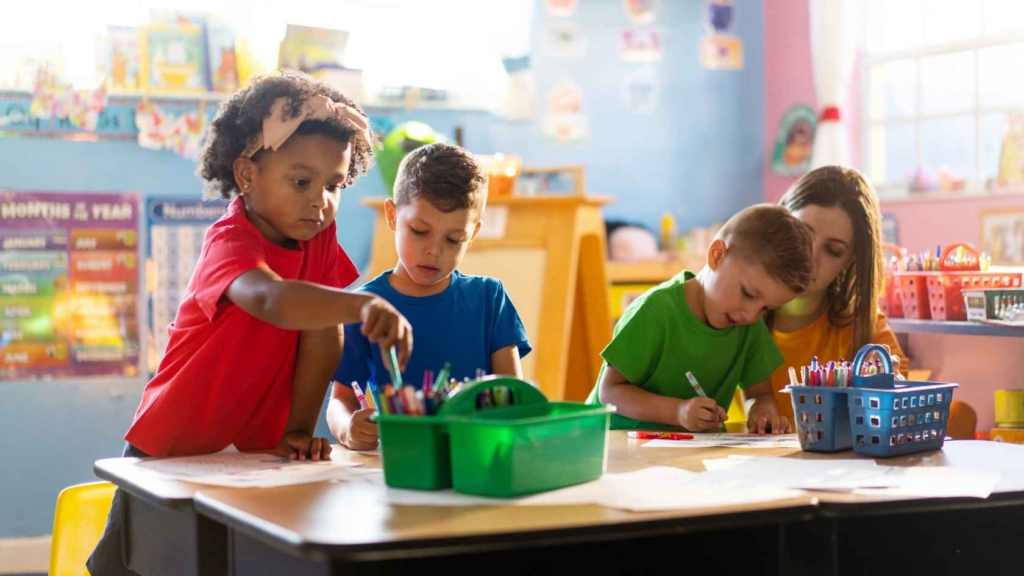
Picture a typical morning in a preschool classroom: a handful of kids crowd around a bin of blocks, two others negotiate who gets the firefighter helmet in the dress-up corner, and a small group shares paint at the art table. These moments are not disruptions. They are the curriculum.
Daycare encourages daily peer interactions for social skill development because limited resources encourage natural negotiation and problem solving. Teachers intentionally keep some materials in short supply-only two toy fire trucks or one easel-so children practice taking turns and talking through fairness. A randomized trial in Oregon showed that when caregivers were trained to organize environments this way, children displayed better cooperation and fewer problem behaviors.
Collaborative projects require children to coordinate actions and share materials, whether they are building a cardboard castle or sorting colored beads. Daily routines encourage children to help one another and contribute to the group, and because this practice happens repeatedly, kids internalize cooperative habits far more steadily than they might during an occasional playdate.
Everyday Play Routines That Teach Taking Turns
Consistent routines help children predict what comes next, and predictable daily schedules create a safe space for social risk-taking. When a child knows the schedule, accepting a wait becomes easier.
Common classroom strategies include:
- Circle time roles: One child is the “helper of the day” who passes out materials, leads a song, or reports the weather. Everyone sees that their turn will come.
- Sand timers and visual aids: Children can practice turn taking with timers or visual aids, such as a two-minute sand timer for the tricycle or counting to twenty before switching a favorite puzzle.
- Simple phrases: Teachers repeat language like “It’s Jonah’s turn now, then it will be Ari’s turn,” which gives children a clear sequence they can rely on.
Waiting is a challenging skill for young children to learn, but modeling good turn taking helps children learn effective sharing over time. Children learn patience through guided play and social interactions, and children learn social skills through repeated participation in meaningful routines. Children begin developing turn taking skills around preschool age, and these small daily opportunities reduce grabbing, tantrums, and conflict over toys.
Guided Problem Solving: Helping Children Work Through Conflicts
Conflict over toys and space is completely normal. High-quality childcare does not avoid these moments-it uses them. Teachers act as emotional coaches to help children navigate conflicts, calmly stepping in to guide rather than simply stopping behavior.
A typical coaching sequence looks like this:
- Name the problem: “You both want the red truck.”
- Invite each child to talk: “Tell me how you feel.”
- Offer choices: “Would you like to set a timer or find another truck while you wait?”
Teachers guide children to express feelings and negotiate solutions, and educators facilitate perspective-taking among children during conflicts by asking questions like, “Do you see that she is upset because she wanted to play too?” Cooperative games require children to negotiate roles and communicate needs, and over time kids begin using these words themselves-moving from pushing or crying to saying, “You can have it after me” or “Let’s build this together.”
This guided interaction connects directly to long-term skills like self-control, negotiation, and understanding that children carry into elementary school and beyond.
Learning Through Observation, Imitation, and Everyday Social Modeling
Children learn sharing by observing peers and adults, especially between about eighteen months and five years old. In a mixed-age childcare classroom, toddlers watch older children share crayons or swap seats at the reading rug, then slowly begin copying those behaviors. Observing peers helps children learn empathy and conflict resolution without a single formal lesson.
Teachers deliberately model cooperation-sharing materials during an art project, asking a colleague politely for help, using kind words when someone is upset. Educators model empathetic responses and polite requests so children hear cooperative language dozens of times each day. A meta-analysis of 42 studies found a meaningful positive link between warm, responsive teacher-child interaction and children’s social skills, including cooperation. Teachers model respectful communication and cooperation for children to imitate, and that repeated exposure builds communication habits kids carry into every relationship.
Age-by-Age: How Childcare Helps Children Learn to Share
Expectations around sharing and cooperation must match each child’s cognitive development. Here is a quick guide:
| Age Group | What Sharing Looks Like | How Childcare Helps |
| Infants (6 weeks–12 months) | Watching others, responding to smiles, passing soft toys | Stable caregivers in the infant room offer gentle encouragement and joint attention. Research shows reciprocal exchanges can emerge as early as 7.5 months. |
| Toddlers (1–3 years) | Side-by-side play, frequent toy struggles | Teachers provide duplicate toys, use “my turn / your turn” language, and keep turns short. Children learn sharing through practice and guidance. |
| Preschoolers (3–5 years) | Cooperative play, role assignment, group art | Children begin developing reliable sharing skills around preschool age. Preschoolers understand sharing is fair but may resist giving up toys. Cooperative play helps children develop empathy and emotional awareness. |
| School-age (5–12 years) | Team games, peer leadership, group projects | Team-based activities encourage children to work together for success. Students develop a deeper sense of fairness and mentorship. |
Children learn cooperation through guided play and shared activities at every stage, and hands on learning keeps growth moving forward.
How Mary Margaret Childcare Supports Social Skills and Confidence
Since 1988, Mary Margaret Daycare and Learning Center has been dedicated to fostering education while building self esteem across the St. Louis Metropolitan area. With nine locations serving children from six weeks to twelve years old, every program level blends fun with structured growth.
Structured group activities help children build sharing and cooperation skills through small-group centers, outdoor play that requires teamwork, and teachers who model kindness rather than simply stopping behavior. Social play teaches children to cooperate and contribute to a common goal, and collaborative group activities require children to coordinate roles-whether they are running a pretend kitchen or completing a science experiment together. The nurturing environment helps children build confidence one interaction at a time.
Families are welcome to explore programs and schedule a tour to see how everyday play supports social development in person.
How Parents Can Support Sharing and Cooperation at Home
Parents are powerful partners in this effort. Simple, consistent habits at home reinforce what children practice during the day:
- Play games together: Board games, building blocks, and backyard activities give kids natural practice with turn taking and encouragement. Cooperative games teach children to listen and celebrate collective achievements.
- Model sharing visibly: Take turns choosing a TV show, divide a dessert, or share a favorite book-and talk about what you are doing so children hear the language of fairness.
- Prepare before social situations: Review simple ideas like, “We’ll share the blue car, and if it’s hard, we can use the timer like at childcare.”
Parents in the St. Louis area can also talk with their child’s teachers at Mary Margaret about specific strategies tailored to their child’s age and temperament, reinforcing the sense of a home-school team.
FAQ
At what age do children really start to learn sharing in childcare?
Infants as young as six to twelve months begin noticing others and responding to shared experiences, but children begin developing reliable sharing skills closer to the preschool years. In toddler rooms, kids mostly practice very short turns with lots of adult support. By ages three to five, children can share more intentionally. It is completely normal for toddlers to resist sharing-consistent experiences in a childcare classroom, gradually makes it feel safer and more familiar.
How can I tell if a childcare program really supports cooperation?
Look for teachers who get down at eye level, narrate feelings, and guide turn taking instead of simply saying “stop.” Listen for cooperative language like “Let’s find a solution” during play. Ask directors how they handle toy conflicts and how they help children develop friendships in the classroom.
What if my child is shy or has trouble joining group play?
Many children need time to warm up. Good childcare teachers gently pair shy kids with one or two kind peers rather than large groups. Ask teachers how they help your child enter play-giving them a specific role or practicing phrases like “Can I help?”-so you can mirror this at home. Repeated, low-pressure exposure usually helps shy children build confidence over weeks.
How do childcare teachers handle serious conflicts or rough behavior?
High-quality programs separate children if needed for safety, then calmly talk through what happened. Teachers focus on teaching replacement skills-using words, asking for a turn, or finding another activity-rather than punishment alone. Ask your child’s center about their behavior guidance policies to make sure they align with your family’s values.
How can I stay involved in my child’s social learning if they are in childcare full-time?
Check in with teachers at drop-off or pick-up about how your child is sharing, taking turns, and getting along with peers. Read daily sheets or classroom apps carefully, then talk with your child about the day’s successes. Participate in center events and parent-teacher conferences to stay connected to the skills your child is practicing each day.