Between their first and third birthdays, toddlers go through one of the most remarkable transformations in human development. They move from babbling and pointing to stringing words into sentences, asking questions, and expressing feelings out loud. For many families, this period overlaps with the hours their child spends in childcare, which raises a natural question: how does that environment shape the way a toddler learns to communicate? The answer, backed by decades of research, is that high-quality childcare can be one of the most powerful catalysts for early language development a young child will ever experience.
Key Takeaways
- The toddler years (roughly ages 1–3) are a critical window for early language development, and high-quality childcare can dramatically enrich everyday communication experiences during this period. Children in language-rich environments hear millions more words by age three compared to those in less stimulating settings.
- Language-rich childcare settings give toddlers far more chances to hear and practice words, gestures, and conversations than most adults can provide alone at home during a workday. Daycare environments help toddlers develop language skills through constant social interaction with peers and trained caregivers.
- Play, routines, songs, and stories in childcare all support early language and cognitive development at the same time, turning ordinary moments into opportunities for vocabulary growth, sentence building, and comprehension.
- Both child care centers and family child care homes can nurture strong early language when they are warm, responsive, and intentional about communication. The setting matters less than the quality of interactions within it.
- Mary Margaret Childcare and Learning Center, serving nine locations across the St. Louis Metropolitan area, intentionally designs toddler classrooms, routines, and teacher training to support early language development every day, blending fun with education since 1988.
Understanding Early Language Development in Toddlers (Ages 1–3)
Early language development refers to the full range of ways toddlers begin to communicate, from babbling and gesturing to speaking their first words and eventually combining them into short phrases. It includes both expressive language (what a child says or signs) and receptive language (what a child understands). Even before a child can speak clearly, they are absorbing the sounds, rhythms, and patterns of the language around them. By 6 months, babies recognize basic sounds of their native language, laying the groundwork for everything that follows.
- Most toddlers can say a few words by 12 months, often starting with familiar labels like “mama,” “ball,” or “dog.” Between 12 and 18 months, single words begin to appear more regularly as children connect sounds with meaning.
- By age 2, children typically use two-word phrases such as “more milk” or “go outside.” Vocabulary at this stage can reach 50 or more words, with rapid expansion happening over the following months. According to the American Academy of Pediatrics, most children build from a few dozen words around age two to several hundred by age three, especially in language-rich environments like quality childcare programs.
- Understanding (receptive language) usually develops ahead of speaking. A toddler may follow simple directions, point to named objects, and respond to questions long before they can say full sentences. This gap is completely normal and a sign that language learning is happening beneath the surface.
- Language development in toddlers is deeply tied to overall child development and school readiness. The words children learn, the sentences they hear, and the conversations they participate in during these early years shape how they will learn to read, solve problems, and connect with other children in preschool and public school.
Why the Toddler Years Are a Critical Window for Language
The first three years are critical for acquiring speech and language skills, and there is a clear biological reason. During early childhood, a child’s brain forms over one million new neural connections every second. This extraordinary pace of growth means that the experiences a toddler has during these years of life literally shape the architecture of their brain. Early language exposure shapes brain architecture and cognitive development in ways that are difficult to replicate later.
- Responsive interactions in early childhood build strong neural pathways. When an adult talks to a child and the child responds with a sound, gesture, or word, and the adult responds again, this “serve-and-return” pattern strengthens circuits for language, attention, and social cognition. Research from the Harvard Center on the Developing Child confirms that these back-and-forth exchanges are among the most important building blocks for healthy brain development.
- Regular conversation in childcare, not just occasional lessons, is what shapes early language and cognitive development. Toddlers do not learn language from overhearing background talk or watching screens. They learn it through direct, meaningful interaction with adults and peers who are paying attention to them.
- Responsive interactions also help build executive function in children, supporting skills like attention control, working memory, and flexible thinking. These cognitive abilities develop alongside language and together predict better outcomes in school and life.
- Science confirms that the first few years are when the brain is most receptive to language input. Missing this window does not mean a child cannot learn language later, but the efficiency and ease of language acquisition are greatest during this period.
How Childcare Environments Support Language Development
Think of a quality childcare center as a daily language lab. From the moment a toddler arrives to the moment they are picked up, they are surrounded by opportunities to hear new words, practice sounds, and participate in conversations. Daycare supports language development through meaningful social exchanges that happen naturally throughout the day, not just during structured “lesson” times.
- Consistent routines like arrival, snack, circle time, and nap give predictable chances to repeat key words and phrases day after day. Repetition is how toddlers move from hearing a word to understanding it to eventually saying it themselves. Daycare settings help build vocabulary through structured group activities that revisit the same language in familiar contexts.
- Being around a group of children the same age and different ages encourages imitation of words, sounds, and phrases through play and peer interaction. Children in daycare settings often learn to communicate better with peers because they have daily practice negotiating, requesting, and responding in real time.
- Trained caregivers intentionally label objects, describe actions, and ask simple questions throughout the day to build vocabulary. This kind of language stimulation has been shown in the NICHD Early Child Care Research Network study to produce effect sizes between .18 and .48 on language outcomes at 15, 24, and 36 months, comparing highest-quality to lowest-quality settings.
- Both child care centers and family child care homes can provide this kind of environment. Centers typically offer age-grouped classrooms and multiple teachers, while family child care providers may offer smaller, mixed-age settings. The key difference is not the type of setting but the quality of language-rich interaction within it. High-quality childcare improves language and cognitive development significantly regardless of the specific format.
Role of Teachers and Caregivers in Early Language
The adults in a toddler’s childcare environment are not just supervising. They are the primary language models and conversation partners who shape how a child learns to speak, listen, and express themselves every day.
- Using “parent-ese” helps children process language more easily. This child-directed speech, characterized by a warm, animated tone and a slower pace, helps toddlers parse sounds, identify word boundaries, and focus attention on what is being said. Children who hear more child-directed speech develop better vocabulary than those exposed primarily to adult-to-adult conversation.
- Teachers follow children’s interests to start meaningful conversations. If a toddler is fascinated by trucks, a skilled caregiver will use that moment to introduce words like “fast,” “big,” “red,” and “wheel,” keeping the child engaged because the topic is something they already care about. Frequent adult-child conversations expose toddlers to new vocabulary in contexts that feel natural.
- Getting down to the child’s eye level for face-to-face interaction allows toddlers to see mouth shapes and facial expressions, which supports both comprehension and pronunciation. Teachers expanding on toddlers’ utterances models correct grammar. For example, when a child says “doggy run,” a teacher might respond, “Yes, the doggy is running fast!” This gentle expansion is one of the most effective strategies for language growth.
- Responsive caregiving reinforces the child’s understanding that communication is effective. When a toddler points and says “juice” and the caregiver responds warmly, the child learns that words are powerful tools. Responsive interactions in childcare enhance children’s language skills by creating a feedback loop where trying to communicate consistently leads to being understood.
- At Mary Margaret, our educators are trained to combine nurturing care with intentional conversation, reinforcing our philosophy of fun balanced with education. Programs like the Toddler Language in the Classroom (TLC) intervention have demonstrated that when teachers receive coaching in these strategies, measurable improvements in language environment quality follow within just 12 weeks.
Everyday Classroom Routines That Build Language
Some of the best language learning happens during ordinary moments that adults might overlook: handwashing, snack time, putting on coats, and cleaning up. These routines are predictable, repeated daily, and rich with chances to connect words to actions.
- Teachers narrate routines in real time. “Now we’re putting soap on our hands. Rub, rub, rub. Let’s rinse!” This kind of running commentary supports vocabulary and early sentence structure by pairing words with experiences that are happening right now.
- Repeated phrases like “First we clean up, then we read a story” strengthen understanding of order and simple grammar. At Mary Margaret, these phrases become part of the classroom rhythm, and toddlers begin to anticipate and even say parts of them on their own.
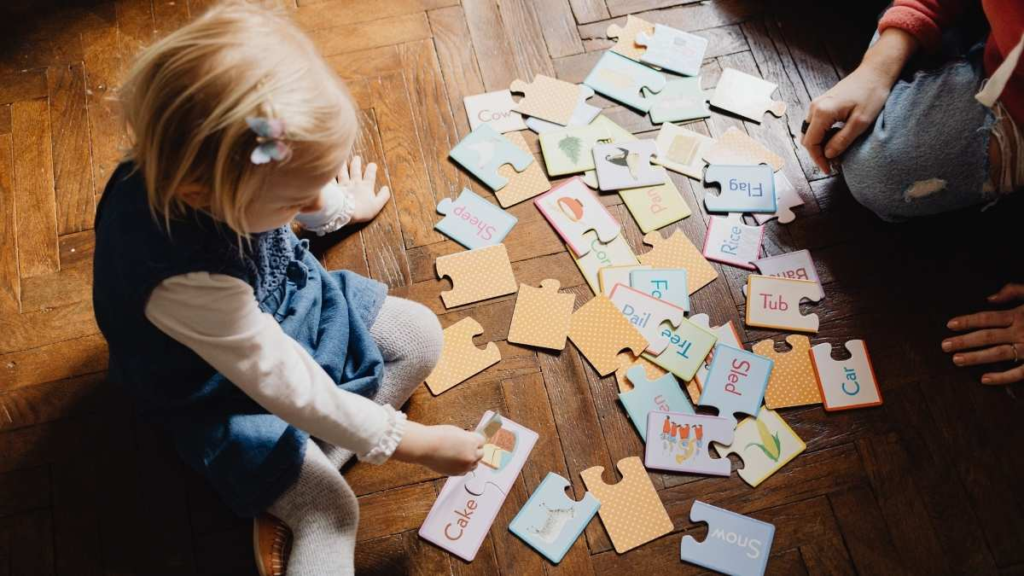
- Picture cues, simple signs, and gestures paired with words help toddlers connect language with actions and expectations. A picture schedule on the wall showing snack, then play, then circle time gives children a visual reference that supports comprehension even before they have the words to describe the sequence. Printed materials like word walls contribute to linking written words with spoken meanings, even for the youngest learners.
- Imagine a toddler classroom at one of our St. Louis locations on a Wednesday morning. A teacher kneels beside a child at the coat hooks and says, “Can you find your blue jacket? That one! Blue jacket, zip, zip, zip.” The child smiles, repeats “zip,” and tries the zipper. Across the room, another caregiver counts crackers onto plates during snack: “One for you, one for me, one more.” These small moments add up to thousands of new words across a week. This is what it looks like when childcare provides care and education at the same time.
Play-Based Learning and Language Growth
Open-ended play is not just fun for toddlers. It is one of the most natural and effective contexts for practicing words, asking for help, and listening to peers. When children play, they are not just moving objects around. They are building language.
- Dramatic play gives toddlers a context to describe actions and negotiate roles. A pretend kitchen introduces words like “cooking,” “hot,” “stir,” and “plate.” Imaginative play encourages toddlers to assign roles and use dialogue, such as “You be the doctor, I’m sick.” These exchanges require children to use language actively, not passively.
- Block play, cars, and sensory tables encourage descriptive language. Big and small, fast and slow, wet and dry, smooth and rough: these are all words that emerge naturally when toddlers are exploring materials with their hands and sharing the experience with peers.
- Teachers at Mary Margaret join in play, modeling simple conversations (“You’re cooking soup. Can I have some?”) rather than directing every move. This approach allows children to lead the interaction while still hearing new skills modeled by an adult.
- Play-based language use is closely tied to early cognitive development, problem-solving, and social skills. When a child explains what they are building or asks a friend for a specific block, they are practicing memory, sequencing, and flexible thinking alongside vocabulary. Daycare environments provide rich social contexts for toddlers to develop their communication skills through exactly this kind of unstructured, guided play.
Books, Songs, and Stories in Early Language Development
Shared reading and music time are core tools for early language in most quality childcare programs. They offer something that everyday conversation cannot always provide: exposure to less common vocabulary, narrative structure, and the rhythmic patterns that support phonological awareness.
- Daily read-alouds with sturdy board books and picture books build vocabulary, listening skills, and comprehension. Reading with children helps them learn words in different contexts, such as encountering the word “brave” in a story about a lion, which gives it meaning beyond what a toddler might hear at the snack table.
- Repetitive songs and fingerplays help toddlers tune into sound patterns and vocabulary. Songs with actions like “Itsy Bitsy Spider” or “Head, Shoulders, Knees and Toes” pair rhythm, rhyme, and movement to support memory and pronunciation. Songs and storytelling introduce vocabulary and encourage communication in a format that feels like play, not instruction.
- Teachers repeat favorite books and songs across weeks in the toddler room so children can begin filling in missing words and phrases. This predictable repetition is backed by research: interactive reading and activities promote rhythm and phonological awareness, which are early building blocks for later reading skills. The ENRICH trial found that when teachers systematically used book-reading plus song routines, children made larger gains in vocabulary and listening comprehension.
- At Mary Margaret classrooms across St. Louis, teachers use seasonal songs, stories about local parks and community places, and books that reflect the backgrounds of the families we serve. This makes story time feel personal and connected to each child’s life outside the classroom.
Peer Interaction and Social Language in Childcare
Being with other toddlers gives children extra reasons to talk. They need to share, negotiate, join games, and express feelings in a group setting, all of which push language development forward in ways that one-on-one adult interaction alone cannot replicate.
- Toddlers in group care hear diverse speech patterns and vocabulary, not just those of one or two family members at home. Peer exposure supports vocabulary and pragmatic skills within social contexts, meaning children learn not only what words mean but when and how to use them.
- Simple cooperative activities like rolling a ball back and forth, building a tower together, or taking turns on a slide encourage words like “mine,” “yours,” “more,” and “help.” Peer communication models natural language use for toddlers during group play, and children in daycare develop social skills faster than those at home because of this daily practice.
- Early practice with turn-taking, greetings, and simple “please” and “thank you” language builds both social and communication skills. Peer interactions can complement adult-led language learning by giving toddlers a chance to practice new words and phrases with someone their own age.
- Mary Margaret’s focus on social-emotional learning supports kind, respectful language among peers, which caregivers model and reinforce throughout the day. When a child says “my turn” instead of grabbing, or “help me” instead of crying, those are language victories that matter.
How Childcare Supports Bilingual and Multilingual Families
Many families in the St. Louis region speak more than one language at home and may wonder how childcare will affect their toddler’s early language. This is a common and completely valid concern, and the research is reassuring.
- Studies in early childhood consistently show that exposure to more than one language does not cause confusion or long-term language delays. A child’s total conceptual vocabulary across both languages tends to be equal to or larger than that of a monolingual peer. The expressive vocabulary in any single language may appear smaller at first, but this is a temporary and normal pattern.
- Quality childcare programs respect and welcome home languages, using key family words when possible. At Mary Margaret, we encourage families to share common words and phrases from their native language so caregivers can understand and connect with each child more effectively.
- We always encourage families to continue speaking, singing, and reading in their strongest language at home while we support English and early language at the center. Consistent, rich conversation in any language supports strong overall language development and later language learning.
- Early bilingual exposure offers real cognitive benefits for young children. Research shows that children with bilingual exposure often develop stronger executive function, which includes skills like flexible thinking, attention control, and the ability to switch between tasks. These advantages have been documented across different types of studies and are linked to the mental exercise of managing two language systems simultaneously.
Child Care Centers vs. Family Child Care Homes for Language Learning
Both child care centers and family child care homes can support strong language development when environments are nurturing and language-rich. The choice between them often comes down to family preferences, logistics, and the specific quality of the program.
- Larger child care centers typically offer age-grouped classrooms, structured curriculum, and multiple teachers. These features support group activities like circle time, music, and story sessions where toddlers hear language modeled by adults and echoed by peers. Many child care providers in center settings follow evidence-based curricula designed to promote language acquisition during the early years.
- Family child care homes often have mixed-age groups and a more home-like setting, which can give toddlers extra chances to hear and learn from older children’s language. When a three-year-old narrates their play to a younger child, the younger child benefits from hearing more complex sentences and new words in a familiar context.
- Regardless of setting, the most important factors are caregiver responsiveness, safety, and a focus on communication and connection. Child care providers who offer care that is warm, talkative, and attentive create environments where toddlers thrive linguistically.
- Mary Margaret is a trusted St. Louis-area childcare provider with center-based programs that blend structure, play, and individualized attention for language development. With nine locations, we offer more flexibility for families seeking consistent, high-quality care across the metropolitan area.
Indicators of a Language-Rich Childcare Program
When parents tour a childcare center or family child care home, knowing what to look and listen for can make a real difference. Not all programs are equally effective at supporting language, and the signs of quality are often visible during even a short visit.
- Watch for teachers talking with children, not over them. Are they asking questions and waiting for toddlers to respond with sounds or gestures? Are they getting down to eye level? Responsive interactions create meaningful language opportunities, and you can spot them in action.
- Listen for varied vocabulary instead of only directions like “don’t,” “stop,” or “no.” In a language-rich environment, adults use descriptive comments, narrate activities, and introduce new words throughout the day. Look for books, labeled pictures, and print displayed at child height.
- Daily schedules posted in simple language and pictures can also be a clue that the program values communication and early literacy. These visual supports help toddlers anticipate what comes next and give teachers natural moments to use sequence words like “first,” “then,” and “next.”
- Childcare centers with lower adult-to-child ratios enhance language learning because caregivers can give more individualized attention. Continuity of care, where the same teacher stays with a group over time, also builds the trust toddlers need to begin experimenting with new words.
- Mary Margaret welcomes families to schedule a tour to see language-rich classrooms in person. Seeing how our teachers interact with toddlers during ordinary moments is the best way to understand what language-supportive care looks like in practice.
Mary Margaret’s Approach to Supporting Toddler Language Development
At Mary Margaret Childcare and Learning Center, we believe that every moment of a toddler’s day is an opportunity for language growth. Across our nine St. Louis-area locations, we design our toddler classrooms, routines, and professional development around this belief.
- Our philosophy is fun balanced with education. Play, songs, and stories are built into every toddler day to nurture early language, and our teachers are trained to turn even transitions and snack time into rich communication experiences.
- Our programs for early childhood, from infant care starting at six weeks through preschool, are designed for whole-child development. This includes social, emotional, physical, and cognitive development alongside language skills. We do not treat language as a separate subject but as something woven into everything a child does.
- Consistent routines, a focus on low child-to-teacher ratios, and warm, nurturing care help toddlers feel safe enough to try new skills and communicate needs. When a child feels secure, they are far more willing to experiment with words, ask questions, and express themselves.
- As children grow, our before- and after-school programs and summer programs continue to support language and communication through age 12, providing continuity that many families value. But during the toddler years, the care provided in our classrooms is specifically calibrated to this critical period of language acquisition.
Partnering With Families to Support Early Language at Home
The strongest language development happens when childcare and home work together. What toddlers hear and practice during the day becomes even more powerful when families reinforce those experiences in the evening and on weekends.
- Teachers at Mary Margaret share simple conversation starters, song lyrics, and book titles with families so they can continue language-building activities at home. When a toddler hears “Twinkle, Twinkle, Little Star” at the center and again at bedtime, the repetition strengthens memory and comprehension.
- Families can talk during everyday routines like car rides through St. Louis neighborhoods, bath time, and dinner. Narrating what you see and do (“Look at that big red truck! It’s so loud.”) uses the same strategies our teachers use in the classroom. Children from language-rich households hear millions more words by age three, and these words do not have to come from a textbook.
- Parents do not need to be teachers at home. They just need to be responsive, talkative adults who listen, respond, and enjoy interacting with their child. Asking open-ended questions, pointing out interesting things, and reading together all count as powerful language input.
- Families can always ask Mary Margaret staff for ideas if they are worried about their toddler’s early language development or want activity suggestions. Our teachers see your child’s growth every day and can offer perspective that complements what you observe at home.
Supporting Toddlers With Emerging or Delayed Language
Children develop at different rates, and some toddlers may show slower early language development than their peers. This can cause worry for parents, but it is important to know that many late talkers catch up, especially with the right support.
- Attentive childcare teachers can notice patterns, such as fewer words than peers, limited eye contact, or little response to a child’s name, and gently share observations with families. These early observations are valuable because they come from adults who see the child in a social setting every day.
- High-quality childcare settings support all children by using gestures, visual supports, repetition, and small-group interaction that can benefit late talkers. These strategies help every toddler, not just those who are already verbal, and they are part of good practice in any language-rich environment.
- If concerns about communication disorders persist, families should consult their pediatrician or a speech-language pathologist. The first three years are critical for acquiring speech and language skills, and early support is usually most helpful. The National Institute of Child Health and Human Development recommends early screening and intervention to give children the best possible start.
- Mary Margaret works alongside families and outside professionals when needed, following recommended strategies within our nurturing routines. We believe in meeting each child where they are and helping them grow at their own pace.
Long-Term Benefits of Strong Early Language Development
Investing in early language during the toddler years pays dividends that extend well beyond the childcare classroom. The words, sentences, and conversations a child experiences between ages one and three create a foundation for learning that lasts through school and into adult life.
- Robust early vocabulary and listening skills support early literacy. Children who enter preschool and public school with strong vocabularies are better prepared to recognize letters, understand stories, and begin learning to read. Children in preschool programs often show better vocabulary skills than peers who did not have access to structured early learning.
- Children who can express feelings and needs with words are better able to form friendships, handle frustration, and participate in group activities. At age 3, children can speak in sentences of three or more words, and by age 4, children can answer simple questions like “What?” and “Where?” These milestones open doors to richer social interaction and classroom participation.
- Early language and cognitive development work together. As children talk about ideas, they are also practicing memory, attention, and problem-solving. High-quality daycare contributes to better language outcomes for toddlers, and those better outcomes translate into stronger academic performance, lower likelihood of needing special education, and greater social-emotional competence.
- Investing in language-rich childcare during the toddler years is one of the most meaningful things a family can do for a child’s growth and future success.
How to Choose the Right Childcare for Your Toddler’s Language Growth
Choosing childcare is both an emotional and practical decision, especially when parents want to support early language. Knowing what questions to ask and what to observe can help families find a program that truly prioritizes communication.
Here are concrete questions to ask on a tour:
- “How do you support toddlers who are just starting to talk?”
- “How often do you read and sing with the children?”
- “What does a typical day look like for a toddler in this room?”
- “How do you communicate with families about a child’s progress?”
- “What training do your teachers have in early language development?”
- Beyond questions, observe how staff talk with children during free play, transitions, and meals, not just during formal “learning time.” The way teachers speak to toddlers during a diaper change or while putting on shoes tells you more about their approach than any brochure.
- Location and hours matter too. Mary Margaret’s nine locations across the St. Louis Metropolitan area offer flexible childcare options for many families, making it easier to find quality care close to home or work.
- If you are looking for a language-supportive childcare program, we invite you to schedule a tour and see our toddler classrooms in action. Our teachers are happy to answer questions about how we support language development every day.
Putting It All Together: Childcare as a Partner in Your Toddler’s Language Journey
The toddler years are a brief, powerful window for language development. During this time, high-quality childcare offers something remarkable: a daily environment filled with conversation, stories, songs, play, and responsive relationships that help young children learn to speak, listen, and express themselves. The research is clear that when childcare is warm, intentional, and language-rich, children benefit in ways that extend far beyond the first few years of life.
- Mary Margaret Childcare and Learning Center is committed to safe, nurturing, and educational childcare that supports the whole child, including early language and cognitive development. Since 1988, we have been a partner to families across the St. Louis Metropolitan area, helping children begin their learning journeys with confidence.
- We encourage parents to view childcare not as a replacement for family interaction but as an extension of the child’s language environment. What happens at home and what happens at the center work together to give toddlers the richest possible foundation.
- Families in the St. Louis Metropolitan area are welcome to reach out, ask questions, and visit a Mary Margaret center to see toddler language learning in action. To learn more about our programs or schedule a visit, contact us today.
Frequently Asked Questions About Toddler Language Development in Childcare
Will my toddler learn to talk later if they spend the day with other children instead of with me?
- In high-quality childcare, toddlers usually have more, not fewer, chances to hear and practice language through songs, stories, conversations, and play with peers and adults. The variety of social interactions throughout the day means children are exposed to a wider range of vocabulary and conversational patterns.
- Research shows that warm, responsive caregivers in childcare settings can support language development as effectively as parents, especially when families also talk and play at home. Responsive interactions create meaningful language opportunities in both environments.
- Staying connected by talking on the way to and from childcare, sharing bedtime stories, and asking about the day helps toddlers link home and childcare experiences and reinforces what they are learning.
How can I tell if my toddler’s language is on track while they are in childcare?
- Look for steady progress over months rather than comparing your child to others on any single day. More sounds, more words, and simple two-word phrases between 18 and 30 months are all positive signs.
- Regular check-ins with both your pediatrician and childcare teachers are helpful because they see the child in different settings and can share observations you might not see at home.
- If a child is not using single words by around 18 months or simple two-word phrases by around age 2, families may want to discuss this with a health professional. Early identification leads to earlier support, which generally produces better outcomes.
Does it matter if I use a different language at home than my child hears in childcare?
- It is not only okay but beneficial to use the language you are most comfortable in at home, while childcare supports early language and English exposure during the day. Further research continues to confirm that bilingualism strengthens rather than hinders language development.
- Consistent, rich conversation in any language supports strong overall language development and later learning. What matters most is the quality and responsiveness of the interaction, not which language it happens in.
- We encourage families to share common home words and phrases with Mary Margaret teachers so they can better understand and communicate with the child, building a bridge between the child’s two language worlds.
What if my toddler is very quiet at childcare but talks a lot at home (or the opposite)?
- It is common for toddlers to use language differently in different types of settings. Some children warm up slowly in groups and save their words for familiar adults, while others speak more freely with peers than with family members at home.
- Parents and teachers should share examples of what the child says in each place to get a full picture of their language skills. A child who is quiet at drop-off but chattering during play may simply need time to feel comfortable.
- If a toddler consistently seems withdrawn or hard to understand in both settings over time, families may wish to seek professional guidance from a speech-language pathologist to refer any concerns and get tailored support.
How does Mary Margaret specifically help my toddler build language skills?
- Our St. Louis-area centers use daily routines, songs, stories, and play-based activities to create a language-rich environment for toddlers. Every point of the day, from breakfast to outdoor time, is designed to include natural opportunities for language practice.
- Our caregivers are trained to respond warmly, model new words, and support each child’s individual pace of language development. We provide care that is both nurturing and intentional, reflecting our belief that babies, infants, and toddlers deserve environments where they can express themselves and be heard.
- We invite parents to schedule a tour through our website so they can see toddler classrooms in action and ask teachers about language support directly. Non profit organizations and community partners are also welcome to connect with us about early childhood education resources in the region.