
Every parent dreads the moment a tired child flails their arms, throws themselves to the floor, and begins to howl. Bedtime meltdowns are a universal parenting experience. After a long day of working, managing a household, and caring for your family, the evening often turns into a battle of wills right when you need rest the most. While you will inevitably face this misery from time to time, specific parenting routines can make a massive difference in your evening dynamic.
Perhaps the most important routine of all is your child’s bedtime schedule. A structured, predictable transition to sleep changes the entire mood of your home. It reduces tears, limits frustration, and ensures that growing bodies get the rest they require to function at their best.
The Deep Connection Between Quality Sleep and Behavior
Lack of sleep is one of the primary factors that makes it harder for kids to manage their emotions. For a two-year-old, controlling big feelings is incredibly difficult on a good day. It becomes nearly impossible if your little one is not getting enough sleep at night. Establishing a bedtime routine takes time and effort, but doing so is vital for your child’s health and your own state of mind.
When young children miss out on necessary rest, they do not always act tired. Instead, they often become more irritable, hyperactive, or easily distracted. Often, parents suffer right along with them as they try to manage these behavioral spikes.
What is most troublesome is that these problems multiply over time. Chronic sleep deprivation can cause more serious behavior issues, learning difficulties, and even physical health concerns like childhood obesity. Children who do not sleep well struggle to focus, have a harder time sharing, and lack the patience needed to learn new skills.
In scientific terms, your child needs to optimize their natural circadian rhythms. Maintaining a consistent sleep routine is critical for positive sleep hygiene. A bedtime that is later than recommended may actually lead to your child waking up frequently at night, waking up too early in the morning, or having trouble falling asleep in the first place. An overtired brain produces cortisol and adrenaline to stay awake, which makes settling down much harder.
Sleep Requirements and Ideal Bedtimes by Age
We regularly hear questions from families regarding the best bedtime for children of different ages. While every child and every home environment is unique, we can provide a few basic recommendations based on child development stages. Understanding what your child needs at their specific age helps you set realistic, healthy expectations for the evening.
Infancy: Learning the Ropes of Rest
Newborns tend to set their own sleep schedule, and this happens by design. Their stomachs can only hold a small amount of milk, so they need to feed every two to three hours around the clock. Circadian rhythms, the internal clocks that tell us to sleep when it is dark and wake when it is light, do not fully emerge until a child is about four months old.
New babies have not developed these rhythms yet, so they usually sleep in two- to three-hour spurts. Exhausted parents know this phase all too well. However, by four months of age, children begin taking more predictable naps during the day and can handle going to bed much earlier. At this stage, aim for a bedtime between 5:30 PM and 7:30 PM.
A bedtime before 7:30 PM remains highly recommended for kids up to age three. As daytime naps reduce to one per day or eventually disappear altogether, overnight sleep becomes even more important. You are not a bad parent for setting an early bedtime and enforcing it. You are simply giving your child the foundation they need to grow.
Toddlers and Preschoolers: The Boundary Testers
Toddlers naturally seek more independence. They want to make their own choices, and their active, curious minds can easily interfere with the sleep you know they desperately need. Even when the sun stays out longer in the summertime, your young child still needs a regular, firm bedtime.
From age three to six, your child might stop taking afternoon naps. Without that daytime rest, they still need an early lights-out time to get enough total sleep. We recommend a bedtime between 6:00 PM and 8:00 PM for this age group.
We also strongly recommend removing television and electronics from the evening routine for children this young. Screens emit blue light that tricks the brain into thinking it is still daytime, halting the production of melatonin. Kids who depend on screens at bedtime simply do not get enough quality sleep compared to kids who wind down without digital devices.
School-Age Children: Balancing Activity and Rest
Children between the ages of seven and twelve are increasingly active. Their brains absorb massive amounts of information at school, and their bodies get worn out from sports, recess, and neighborhood play. At this age, kids will frequently beg you for ten more minutes or ask to stay up late on weekends and over summer break.
An occasional late-night sleepover or family movie night is perfectly fine. However, they should still be getting to bed between 8:00 PM and 9:00 PM on most standard nights. Their growing bodies need significant recovery time to process the day’s events and physically grow.
Teenagers: The Surprising Need for More Sleep
Teenagers actually need more sleep than you might think. In fact, their rapidly developing brains and shifting hormones mean they require more sleep than most adults do. Do not be afraid to enforce a bedtime for your older child.
Too many teens stay up late into the night playing video games, watching videos, or chatting on social media. This chronic late-night screen time can severely hurt their academic performance and mental health. Be the strict parent and take those screens away from them overnight. Removing devices from the bedroom helps them get the extra sleep they desperately need and sets them up with healthy sleep habits for their adult lives.
Proven Tips to Make Bedtime Easier for the Whole Family
Like so many other aspects of parenting, making bedtime easier requires developing a routine and sticking with it through the difficult moments. Allow for a little flexibility, but keep the structure intact. Your bedtime routine may last between thirty minutes to an hour, but it should start at the exact same time every night. This takes energy on your part, but the peaceful evenings that follow make the effort absolutely worth it.
Make Sleep a Priority with a Predictable Routine
Children thrive on routines. A predictable bedtime routine acts as a signal to your child’s brain that the day is ending. Developing a nightly ritual where your child knows to change clothes, brush their teeth, and calm their body down goes a long way toward making the evening stress-free.
Add a special, connecting touch to associate positive feelings with bedtime. You might let your child choose their favorite stuffed animal, sing a specific lullaby, or read a couple of books together in a quiet chair. When you do the exact same things in the exact same order, you remove the element of surprise. Your child stops fighting the process because they know exactly what comes next.
Set Up a Cozy, Restful Environment
The physical sleep environment matters just as much as the routine. Your child needs a quiet, dark, and comfortably cool room to sleep in each night. Even if your child shares a room with a sibling, try to make the environment as calm and peaceful as possible.
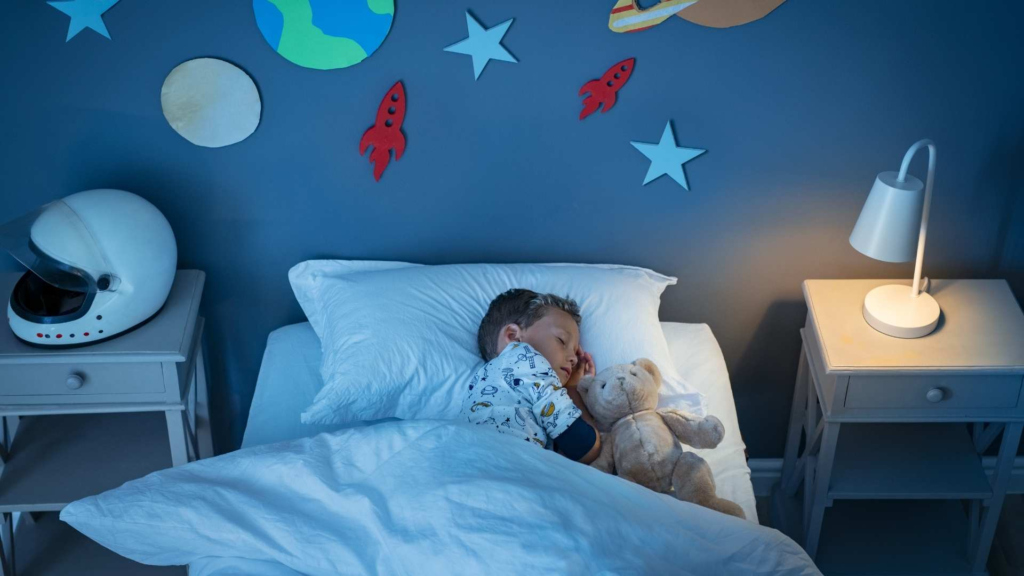
Use blackout curtains to block out summer sunlight or streetlamps. Turn on a white noise machine to muffle the sounds of the household or neighborhood. Let your child sleep with a familiar comfort object, like a special blanket or a favorite teddy bear. These items provide them with a deep sense of security, helping them self-soothe if they wake up briefly in the middle of the night.
Avoid the “One Last Thing” Trap
A small, healthy snack before bed is perfectly acceptable if your child is genuinely hungry. However, you must avoid sweets and anything containing caffeine. Offer something simple and filling, like a piece of cheese, a few crackers, or a small slice of apple.
Give your child plenty of advance notice before the routine begins. A simple warning like, “We are starting our bedtime routine in ten minutes!” helps your child mentally transition away from their toys.
Finally, you must avoid the infamous “one last” trap. Your child will inevitably ask for one last drink of water, one last trip to the bathroom, or one last cartoon episode. Try to absorb some of these requests into the main routine. Keep a water bottle on their nightstand and make a final bathroom trip mandatory before getting into bed. Once the lights are out, hold firm. Your child will be just fine without one last episode of their favorite television show.
How Mary Margaret Daycare Supports Healthy Sleep Habits
At Mary Margaret Daycare and Learning Center, we understand how vital sleep is to early childhood development. Since 1988, we have partnered with families across the St. Louis metropolitan area to provide care that supports the whole child. We serve children from six weeks to twelve years old across our nine convenient locations, balancing fun with education every single day.
We help make your evenings easier by enforcing consistent, healthy nap schedules during the day. Our classrooms provide structured rest periods so your child does not become overtired by the time you pick them up. Furthermore, our play-based curriculum and active outdoor time ensure that your child burns off their endless energy. When children engage their minds and bodies in a safe, nurturing environment all day, they naturally feel more ready to sleep when they return home.
A peaceful bedtime is possible for your family. By understanding your child’s sleep needs, setting clear boundaries, and establishing a comforting routine, you can turn a nightly battle into a quiet, connecting end to your day.