Key Takeaways
- Play-based learning is one of the most effective, research-backed ways to support whole-child development from birth through age 8, building cognitive, social, emotional, and physical skills simultaneously.
- At Mary Margaret Daycare and Learning Center, play is intentionally woven into daily routines to build social, emotional, language, and early academic skills for children from 6 weeks to 12 years old.
- Guided play, where teachers set goals but children lead the activity, consistently outperforms drill-based instruction for early literacy, math, and executive function development.
- Children in high-quality play-based programs are well prepared for kindergarten and elementary school because they practice problem solving, self-regulation, and collaboration every day.
- Play-based learning can be adapted for diverse needs, including children with autism or developmental delays, through intentional support and collaboration with families.
Introduction: Why Play Matters So Much in the Early Years
It’s 9:15 on a Tuesday morning at a Mary Margaret Daycare preschool classroom in St. Louis. Four-year-olds huddle around a block center, carefully constructing what they’ve decided is the “St. Louis Zoo.” One child counts the animal figurines while another negotiates which blocks should form the elephant enclosure. A third child announces she’ll be the zookeeper and begins writing “tickets” on scrap paper. Without realizing it, these children are practicing early math, language development, social and emotional development, and fine motor skills, all before snack time.
This scene represents what decades of early childhood research confirms: children learn best through active, meaningful, and socially interactive experiences. Yet since the late 1990s, pressure for earlier academics and high stakes testing has reduced playtime in many kindergarten and preschool classrooms across the United States. Despite the recognized benefits of play-based learning, many educators face challenges in implementing it due to historical shifts towards more rigid, skills-focused curricula, particularly in underserved communities.
Current research from 2010 through 2024 consistently shows that reducing play does not improve long-term achievement. Strong play-based programs, however, do improve readiness and well being. Play-based learning encourages children to become active investigators, asking questions and finding solutions instead of just receiving information.
This article will show parents and educators how play based learning supports early childhood development and how centers like Mary Margaret integrate play with intentional teaching across all age groups.
What Is Play-Based Learning?
Play-based learning is a research-supported educational approach where play is the primary vehicle for children to explore, discover, and learn about their world. It is not simply a “break” from learning, it is how early learning actually happens. This approach applies from infancy through early elementary grades and recognizes that young children construct knowledge through hands-on exploration rather than passive instruction.
Three core forms of play define this approach. Free play is entirely child-directed, where children choose activities and direct their own exploration. Guided play is adult-framed but child-led, where teachers set up environments with specific learning goals while children retain agency in how they engage. Games involve structured rules with clear learning objectives.
At Mary Margaret classrooms, teachers act as facilitators rather than lecturers. They design rich environments featuring blocks, dramatic play areas, and sensory tables. Teachers play a crucial role in creating environments that facilitate playful learning, which helps children master content and develop essential skills for future success. When helpful, educators step in with open-ended questions or prompts to extend thinking without taking over the child’s experience.
This approach connects directly to how young children actually learn best. Rather than worksheets and rote memorization, children engage with concepts through active manipulation, meaningful contexts, and social interaction with peers and adults.
The Core Elements of High-Quality Play-Based Learning
Decades of child development research have identified several features that make play truly educational. Understanding these elements helps parents recognize quality when they see it.
High-quality playful learning is self-chosen and self-directed, giving children genuine agency over what they explore and how. It is enjoyable and intrinsically motivating, children engage because they want to, not because of external rewards. Quality play is active and hands-on, involving direct manipulation of materials rather than passive observation. It is process-oriented, focusing on exploration and discovery rather than achieving a single “correct” answer.
Play-based learning fosters creativity and imagination, which are crucial for children’s cognitive and social-emotional development, as it allows them to explore problem solving and interpersonal skills. Quality play is also socially interactive, involving peers and adults in ways that promote language, cooperation, and collaborative thinking.
In a Mary Margaret preschool classroom, teachers intentionally protect 45 to 60 minutes of center time daily where these elements emerge naturally. Teachers can facilitate guided play by embedding learning goals into play activities, allowing children to lead their own exploration while still achieving educational objectives.
Consider children planning a “restaurant” in the dramatic play area. They choose roles, cook, server, customer, directing the scenario themselves. They negotiate who does what, create menus by writing or drawing, handle “money” for transactions, and problem-solve when disagreements arise. Purposeful play like this integrates language, math, social skills, and creative thinking simultaneously.
How Play-Based Learning Supports Whole-Child Development
Play is not simply “nice to have” in early childhood programs. Play-based learning supports development across physical, cognitive, social, and emotional domains, every area recognized by human development experts as essential for lifelong success.
Cognitive and Early Academic Skills: When children play with blocks, they develop spatial reasoning and early math concepts. Counting blocks, comparing heights, and experimenting with balance all build foundational academic skills. Play triggers brain development, allowing children to test hypotheses, think creatively, and master early math and science concepts. Pretend stores support early numeracy and money concepts as children make purchases and give change. Symbolic play, such as pretending to read or write, helps children practice cognitive skills necessary for literacy development, making it essential to integrate into early childhood classrooms.
Language and Communication: Play-based learning significantly enhances children’s language development by allowing them to explore new vocabulary in an organic and relevant context, particularly during pretend play scenarios. When children narrate roles in a “doctor’s office” or “fire station,” they practice communication skills naturally. Staff can model sophisticated vocabulary, words like “stethoscope” or “evacuate” and children acquire them through meaningful context rather than flashcards. Story-based play connected to books extends early literacy development further.
Social-Emotional Development: Group play helps children develop essential social skills including turn-taking, developing empathy, understanding rules, and recognizing different perspectives. Children practice essential interpersonal skills such as sharing, negotiation, empathy, and conflict resolution through collaborative play. Cooperative play during playground games and building projects teaches children how to navigate relationships, practice empathy, and work toward shared goals. This social emotional development forms the foundation for success in school and life.
Physical Development: Active play develops gross motor skills, while manipulative play sharpens fine motor skills and hand-eye coordination. Toddlers stacking large foam blocks build balance and coordination. Preschoolers painting at easels develop hand control essential for writing. School-age children in after-school programs using climbing structures and team games develop strength, cardiovascular fitness, and body awareness.
Executive Function and Self-Regulation: Executive function skills, focus, working memory, and the ability to regulate behavior are crucial for later success in reading, math, and emotional regulation. Waiting for a turn in a board game requires impulse control. Following multi-step directions in a scavenger hunt develops attention. Staying in character during imaginative play while responding to peers requires cognitive flexibility. Play challenges the brain to develop problem-solving, critical thinking, and memory skills naturally.
Mary Margaret’s daily schedules intentionally include varied play experiences supporting all these domains, not just early academics.
The Play Spectrum: From Free Play to Guided Play and Games
Effective early childhood education offers a balance across what researchers call the “play spectrum.” Play can be thought of as lying on a spectrum that includes free play, guided play, and games, with varying degrees of child agency and adult involvement.
Free play is child-directed, voluntary, and flexible, allowing children to explore and express themselves, which is crucial for their social, emotional, and developmental skills. Picture preschoolers at a sensory table choosing how to explore water, sand, or rice with cups and funnels. Children follow their own interests entirely, building autonomy and intrinsic motivation.
Guided play involves a more active role for teachers, who can focus children’s play around specific learning goals while still allowing children to direct their own activities. A Mary Margaret teacher might set up a “post office” center with envelopes, stamps, and name cards to practice writing and letter recognition. Children decide how to use materials and in what sequence. In guided play, teachers ask probing questions that guide children’s exploration while allowing them to direct the activity, thus supporting their learning goals without taking over the play.
Research indicates that children engaged in guided play demonstrate greater vocabulary and spatial skills compared to those involved in free play, highlighting the effectiveness of structured play in learning. Teachers who view play as a conduit to learning are more likely to employ guided play, which can yield a broader range of academic outcomes compared to free play.
Structured play and games involve predetermined rules with learning objectives. Physical games like “Red Light, Green Light” develop impulse control. Tabletop dice games help kindergarten children practice counting and number recognition. These games build new skills within clear frameworks.
Mary Margaret early childhood educators deliberately move along this spectrum throughout the day, starting with free play centers, moving into short guided activities around math or literacy, and ending with outdoor games that combine physical activity with collaboration.
Research-Backed Benefits of Play-Based Learning
The evidence supporting play-based approaches draws from foundational work by theorists like Jean Piaget and Lev Vygotsky, as well as contemporary researchers. Studies from the 2000s through 2024 consistently demonstrate that guided play leads to stronger vocabulary, spatial reasoning, and early math outcomes than direct instruction alone in preschool and kindergarten classrooms.
Play stimulates the formation of millions of neural connections every second, creating a strong foundation for ongoing cognitive function and health. This brain-building happens most effectively when children are actively engaged rather than passively receiving information.
Children in high-quality play-based programs typically show better long-term attitudes toward school, greater resilience, and stronger problem solving skills than peers in strictly academic early programs. Play-based learning helps cultivate a lifelong learning love, making children more enthusiastic and confident students.
Executive function development through play has been specifically linked to later success in reading, math, and emotional skills. The implementation of play-based learning can be inconsistent across settings, as teachers’ perspectives on the role of play vary significantly. However, programs committed to play-based approaches, like Mary Margaret has been since 1988, show consistent positive outcomes.
This aligns with Mary Margaret’s philosophy of “Fun Balanced With Education.” For over three decades, the centers have used play-based, developmentally appropriate classroom practices to support children across the St. Louis area, demonstrating that play and learning are not opposites but partners.
How Mary Margaret Daycare and Learning Center Uses Play Every Day
Mary Margaret’s nine locations serving the St. Louis metropolitan area provide play-based learning for children from 6 weeks to 12 years old. This continuity ensures children experience consistent, developmentally appropriate approaches as they grow.
Infants experience sensory play through soft toys, tummy time activities, and simple cause-and-effect toys. These early experiences support brain development and secure attachment in a nurturing learning environment. Caregivers engage in peek-a-boo, gentle musical play, and responsive interactions that lay foundations for later learning.
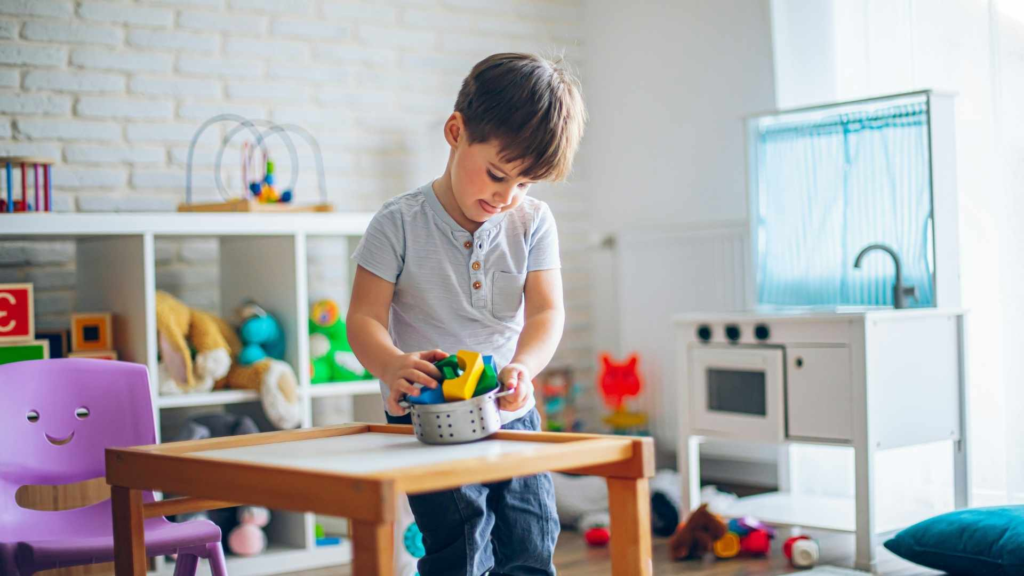
Toddler classrooms feature accessible shelves with blocks, a play kitchen, picture books, and simple puzzles. Educators follow children’s interests while embedding language coaching and social skill development. Water play with cups and funnels, simple pretend cooking, and large block towers help toddlers develop across domains simultaneously.
Preschool and pre-K rooms provide longer blocks of center time for complex dramatic play. Children might build a “Gateway Arch” city, run a “grocery store” complete with cash register and shopping lists, or set up a “vet clinic” with stuffed animals as patients. These rich pretend play scenarios connect to early literacy and math goals while children direct their own experiences.
Before-and after-school and summer programs for school-age children include clubs, field trips around St. Louis, and project-based learning. Science experiments, group games, and arts and crafts extend learning beyond typical classroom experiences. A visit to the zoo might spark follow-up role playing, art projects, and research activities.
Throughout all programs, consistent routines and warm, responsive teachers allow children to feel secure enough to explore, take risks, and engage deeply through play.
Addressing Common Concerns About Play-Based Learning
Many parents worry about kindergarten readiness, early reading, and math when they hear “play-based.” These concerns are understandable but rest on a misconception.
Play-based learning is not the absence of structure or goals. At Mary Margaret, teachers plan specific learning objectives, letter sounds, counting to 20, recognizing shapes and embed them into playful activities. Teachers often struggle with balancing play-based learning with academic rigor, as there is a misconception that play detracts from educational outcomes. Quality play-based programs prove otherwise.
Children can and do learn to recognize letters, numbers, and early sight words through games, songs, story-based activities, and meaningful writing tasks. When children sign their names on artwork or make labels for block buildings, they practice literacy skills in contexts that matter to them.
Consider the difference between a worksheet requiring children to circle shapes versus children sorting real objects by shape, building with different shaped blocks, and describing what they notice. The hands-on approach teaches science concepts and critical thinking more deeply. Incorporating play into early childhood education can enhance children’s cognitive, social, and emotional skills, as it allows them to explore and process information in a safe and engaging environment.
Play allows children to learn at their own speed, catering to diverse learning styles and abilities. For children with autism or speech delays, teachers break tasks into smaller steps, model play skills, and use visual supports. Play-based learning creates a safe, enjoyable environment that helps children navigate emotional challenges and adversity. Collaboration with families ensures consistent strategies between home and center.
Practical Examples of Play-Based Learning Activities by Age
These concrete examples help parents picture what happens at each stage and offer ideas to try at home.
Infants (6 weeks–12 months): Soft sensory mats with varied textures, black-and-white contrast cards, peek-a-boo games, and simple musical instruments support sensory and emotional development. These activities build neural connections and secure relationships with caregivers.
Toddlers (1–3 years): Water play with cups and funnels develops problem solving as children experiment with pouring and filling. Simple pretend cooking with play food and dishes builds language as children name ingredients and describe actions. Push-and-pull toys and large block towers strengthen motor skills while teaching cause and effect.
Preschoolers (3–5 years): Rich pretend scenarios let children become doctors, firefighters, or restaurant workers, integrating language, math, and social skills. Cooperative building projects require negotiation and planning. Matching and sorting games develop cognitive skills, while story reenactments connected to favorite books build early literacy development.
School-Age Children (5–12 years): Board games develop strategy, math, and turn-taking. Group science challenges, like building a bridge from craft sticks, combine physics concepts with collaboration. Outdoor team games blend physical activity with planning, communication, and critical thinking.
Mary Margaret summer programs turn field trips into extended learning. A visit to a local museum might inspire follow-up dramatic play, art projects, and conversations that help children progress in understanding their world.
How Families Can Support Play-Based Learning at Home
Families do not need expensive toys or elaborate setups to support rich play at home. Simple, low-cost materials often work best.
Cardboard boxes become houses, cars, or spaceships. Pots, pans, and wooden spoons create a kitchen orchestra. Scarves transform children into superheroes or dancers. Recycled containers become building materials or sorting tools. Sidewalk chalk turns driveways into canvases for symbolic thinking and creative expression.
Practical activities support development naturally. Cooking together involves measuring, counting, and following steps. Neighborhood “treasure hunts” encourage children to observe shapes, letters, or colors. Family game nights practice turn-taking, rule-following, and graceful losing.
The teacher’s role at home is different, parents become play partners. Follow your child’s lead rather than directing. Ask open-ended questions: “What do you think will happen if…?” Join pretend scenarios without taking over. When one child invites you into their restaurant game, be a customer and let them run the show.
Limit screen time for young children. When screens are used, choose interactive, age-appropriate content and pair it with offline extension, drawing characters from a story, acting out scenes, or building related projects.
Frequently Asked Questions About Play-Based Learning
These questions address specific concerns not fully covered above, helping families make informed decisions about their children’s education.
How do teachers assess learning in a play-based classroom?
Educators at Mary Margaret use observations, anecdotal notes, photographs, and children’s work samples rather than relying solely on paper-and-pencil tests. Teachers document growth over time in language, social skills, problem solving, and early academics during everyday play activities. Most children demonstrate progress through increasingly complex play, richer vocabulary, and stronger peer relationships. Families receive regular communication through conferences or progress reports that include specific examples from their child’s play experiences.
Will my child be ready for kindergarten if most of the day is spent playing?
High-quality play-based programs like Mary Margaret intentionally build the skills kindergarten teachers expect: listening, following directions, recognizing letters and numbers, and working cooperatively with other children. Children practice these skills in meaningful contexts—writing names on artwork, counting snacks, retelling stories through puppets—rather than through extended periods of seatwork. Children who develop strong executive function, emotional regulation, and problem solving through play typically adjust more smoothly to kindergarten routines and expectations.
How does play-based learning work for children with autism or developmental delays?
Teachers model play skills step by step, use visual supports, and pair children with supportive peers. Play adapts to each child’s interests and comfort level—perhaps starting with preferred toys or sensory materials before expanding. Allowing children to engage at their own pace while providing scaffolded support helps all children develop new knowledge and skills. Collaboration with families and therapists ensures consistent strategies, making play a powerful tool for every child’s development.
What does a typical day look like in a play-based preschool classroom?
A Mary Margaret preschool day might include arrival with free choice centers, morning circle with songs and stories, guided small-group activities, outdoor play, lunch, rest time, and afternoon centers or projects. Within this structure, children have frequent opportunities for both child initiated activities and guided experiences, indoors and outdoors. Routines provide security while play offers variety, challenge, and joy.
How is a play-based program different from a more traditional academic preschool?
In play-based classrooms, children learn through centers, projects, and hands on exploration rather than worksheets and whole-group drills. Learning goals, letters, numbers, science concepts, remain equally rigorous, but the path involves active engagement rather than passive instruction. Many teachers in public schools and traditional programs rely heavily on direct instruction, while play-based approaches honor how children develop naturally. Children in play-based settings often show stronger curiosity, confidence, and love of learning that carries into elementary grades.
When children feel safe, engaged, and joyful, learning happens naturally. At Mary Margaret Daycare and Learning Center, play is not a break from education, it is education at its most effective. Since 1988, families across the St. Louis area have trusted Mary Margaret to nurture their children through developmentally appropriate, play-based experiences.
Ready to see play-based learning in action? Visit one of our nine St. Louis locations to meet our educators, observe our classrooms, and discover how your child can thrive through the power of play.