
Key Takeaways
- Predictable daily routines in child care help children feel safe, calm, and ready to learn, which directly boosts their confidence and emotional stability.
- Structure does not mean rigidity: at Mary Margaret Daycare and Learning Center, consistent schedules are balanced with plenty of free play, exploration, and child choice throughout the day.
- Confident children participate more fully in early childhood education activities, building both academic skills like early literacy and math and social development through daily interactions with peers and caregivers.
- Families in the St. Louis metropolitan area can see this structure in action by scheduling a tour at any of Mary Margaret’s nine childcare locations.
Introduction: Why Routine Builds Confident Kids
Picture a toddler named Ellie walking into her first day of child care in August 2026 in St. Louis. She clings to her mom’s leg, eyes wide. But within three weeks of the same warm greeting, the same morning song, and the same predictable rhythm, Ellie walks through the door on her own, waves goodbye, and heads straight to the puzzle table. That shift did not happen by accident. It happened because her environment was structured enough for her to know exactly what to expect.
A structured childcare schedule is a daily plan built around predictable blocks: arrival, meals, circle time, learning centers, outdoor activities, rest, and pick-up. It is not a minute-by-minute drill. It is a dependable rhythm that repeats Monday through Friday so children can settle into it and begin to trust their surroundings.
When predictability and security lower anxiety in children, something important happens. They stop worrying about what comes next and start focusing on what they can do right now. Structured daycare schedules support emotional stability in children, freeing them to try new things, make friends, and take pride in small accomplishments. That is how a structured childcare schedule helps children feel confident.
The rest of this article walks through a typical day at Mary Margaret Daycare and Learning Center and explains how each part supports confidence, education, and social development for children from six weeks to twelve years old.
How Predictable Routines Help Children Feel Safe
Emotional safety is the foundation for learning. Confidence grows when children feel safe every single day, not just on the easy ones.
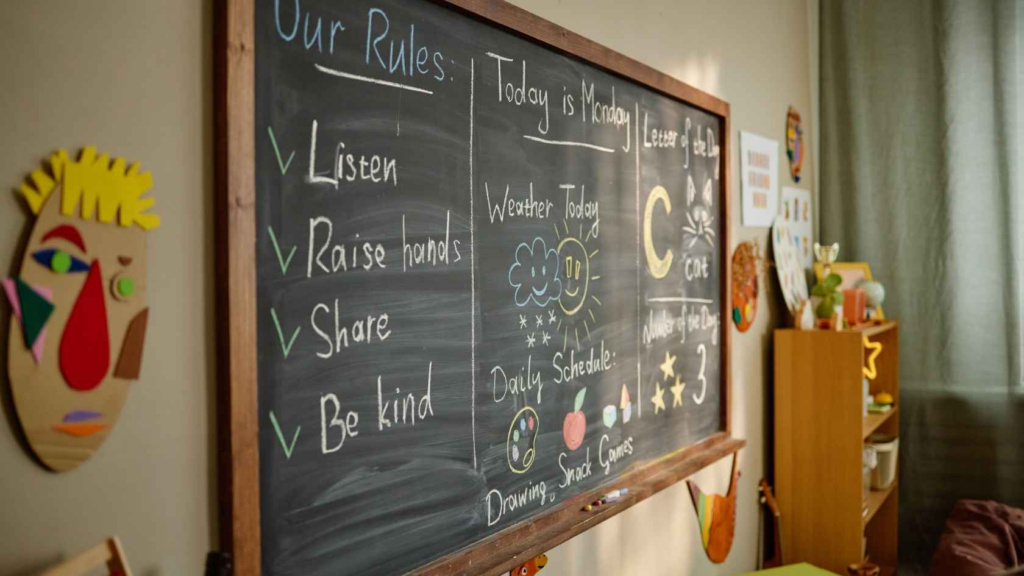
At Mary Margaret, each classroom features a posted visual schedule with pictures for younger children and written words for older ones. The schedule shows the day’s order clearly: arrival, circle time, centers, outdoor play, lunch, rest, afternoon activities, and pick-up. Visual schedules can help children anticipate daily activities, giving even pre-verbal toddlers a way to understand what is coming.
Repeating the same rhythm Monday through Friday helps children in every age group understand what to expect, even when specific activities change. Children who know what to expect have reduced stress. Consistent routines reduce stress and confusion for children, and that calm baseline makes it possible for them to focus on learning rather than worrying.
Teachers also verbally preview transitions throughout the day. A simple phrase like “After snack, we’ll go outside” gives children advance notice and reduces surprises. Research shows that combined visual and verbal cues significantly lower challenging behaviors during transitions, especially for children who are sensitive to change.
This sense of safety is especially helpful during the first few weeks of enrollment or after big life changes like a new sibling, a family move, or a school transition. Children feel safe when moving through predictable activities, and that safety is the launchpad for confidence.
From Security to Self-Esteem: The Link Between Routine and Confidence
Children build confidence when they can successfully move through their day and meet expectations on their own. It begins with security, but it does not stop there.
Structured routines provide opportunities for children to practice self-help skills daily. Hanging up a coat, washing hands before lunch, choosing a learning center, putting crayons back in the bin-these are not chores. They are moments where a child thinks, “I can do this myself.” Children mastering daily tasks reinforces self-esteem and independence, and those repeated wins accumulate into a strong sense of personal capability.
Over months, children start to see themselves as capable learners and problem-solvers. Structured routines help children build confidence in their abilities, not through praise alone but through genuine, repeated experience. Data from the Early Head Start Research and Evaluation Project showed that family and childcare routines at early ages predicted better self-regulation and cognitive development by 36 months, especially among children from lower-income settings.
Consider a shy 3-year-old who spends the first two weeks of enrollment watching circle time from the edge of the rug. Because the routine stays the same, she begins to recognize the hello song, the helper chart, and the story pattern. By week four, she is sitting in the circle. By week six, she volunteers to be the weather helper. That progression from observer to participant is confidence in action.
Morning Arrival: Confident Starts to the Day
Between roughly 6:30 and 8:30 a.m., families arrive at a typical Mary Margaret child care center in St. Louis. What happens in those first moments sets the tone for the entire day.
Teachers greet each child by name, at eye level, with a consistent arrival routine: sign in, put belongings in a cubby, and choose a quiet activity to ease into the morning. This structured but warm start helps children separate from parents more confidently over time. Many children, especially toddlers and preschoolers, need several weeks to master the goodbye, and a reliable arrival routine shortens that adjustment period.
Quick parent-teacher check-ins about sleeping patterns, mood, or health help caregivers support each child’s emotional needs. These conversations take just a moment but give teachers the guidance they need to offer the right support throughout the day.
Early, low-pressure choices like puzzles, books, or blocks give children a sense of control first thing in the morning. Children build trust in caregivers through reliable routines, and that trust begins the moment they walk through the door.
Circle Time: Building Confidence in a Group
Around 9:00 a.m., toddlers and preschoolers gather for circle time-a short group session filled with songs, stories, calendar talk, and weather observation. It is often the highlight of the morning.
Knowing that circle time happens at the same time every day helps even reserved children anticipate what will happen and feel less overwhelmed in a group setting. Teachers use consistent elements-the same hello song, a daily helper chart, visual cues on the board-so children can predict what is coming and participate more confidently.
Circle time enhances children’s listening skills and group participation. Daily routines support developmental skills like listening and cooperation, and circle time is where those skills get daily practice. Daily group activities teach children sharing and cooperation in a low-stakes, supportive environment.
Circle time also connects directly to academic skills:
- Early literacy through listening to stories and identifying letters
- Early math through counting friends present and days of the week
- Language development through answering simple questions and learning new vocabulary
The social development piece matters just as much. Taking turns speaking, listening to friends, and leading small jobs like line leader or weather helper all give children practice with leadership in a safe, familiar format.
Structured Learning Centers: Choice Within a Clear Framework
Learning centers are specific areas within the classroom-blocks, art, dramatic play, science, and a reading corner-that children can choose from during a set time block. The schedule clearly tells children when center time starts and ends, and teachers use timers, songs, or visual cues to mark transitions.
Children build confidence by making their own choices inside that structure. Picking a center, staying with it, and finishing a simple task like building a tower, sorting shapes, or completing a drawing gives them ownership over their learning. This balance of freedom within a framework is how many children discover what they enjoy and where they excel.
Centers also connect directly to academic skills:
- Block play supports early math and spatial reasoning
- Art strengthens fine motor skills and creativity
- Dramatic play builds language, problem-solving, and social skills
Teachers at Mary Margaret gently coach children to set small goals during center time. “Let’s add three more blocks to your tower” or “Can you draw one more detail on your picture?” helps children experience success and pride without pressure. That effort leads to real growth over time.
Learning Through Play: How Structure Supports Exploration
At Mary Margaret Daycare and Learning Center, structure and play are partners, not opposites. The schedule protects large blocks of time for meaningful play so children can explore, create, and discover at their own pace.
Predictable times for free play-morning centers, afternoon indoor play-help children relax into deeper, more focused exploration. When they are not worried about sudden changes, they can concentrate on building, imagining, and problem-solving. Play-based learning in daycare fosters cognitive development in children, and that development accelerates when the environment feels stable.
Teachers set clear expectations and boundaries during play: how many children per center, when clean-up time begins, and how to use gentle hands. These boundaries do not limit play. They create a safe container for it, so children can play confidently without chaos.
Play-based learning fosters friendships and communication skills as children negotiate roles in pretend play, collaborate on block structures, and explore sensory bins together. When adults acknowledge effort and choices-“You worked so hard on that puzzle” rather than just praising the finished product-children internalize that trying matters as much as succeeding.
Meals and Snacks: Practicing Independence and Social Skills
Regular meal and snack times-mid-morning snack, lunch around midday, afternoon snack-are built into the daily schedule at every Mary Margaret location. These predictable meals do more than nourish growing bodies.
Knowing when meals happen reduces anxiety about hunger and helps children trust that their needs will be met consistently. Familiar tasks like washing hands build a child’s sense of capability, and the routine steps around mealtime-washing up, sitting at the table, passing items, cleaning up-give children predictable actions to master.
Snack time encourages polite behavior and social interaction. Children practice manners, wait for a turn, chat with friends, and participate in short conversations at the table. These small daily interactions are where social skills get polished.
For older children in before- and after-school programs, structured snack time provides a dependable pause to decompress and reset between school and afternoon activities. It is a simple thing, but it matters.
Outdoor Play: Confident Movement and Risk-Taking
Mary Margaret schedules one or more daily outdoor play blocks, weather permitting, across its St. Louis metro locations. Fresh air and physical movement are essential to a child’s day.
Having outdoor time at predictable intervals-mid-morning and mid-afternoon, for example-helps children pace their energy and look forward to physical play. Consistent playground routines like lining up, reviewing safety rules, and using specific areas for different age groups allow children to take age-appropriate risks with confidence. Climbing a little higher, running a little faster, balancing on a beam-these are the moments where physical confidence grows.
Gross motor skill development-balance, coordination, strength-connects directly to self-confidence. When a child masters a new physical challenge over weeks and months, the pride is visible.
Occasional special outdoor experiences like water days in July, nature walks in nearby parks, or field trips during summer programs still fit into an understandable daily rhythm. Children know when outdoor activities happen, so even new experiences feel manageable within the familiar schedule.
Quiet Time and Rest: Resetting for Emotional Confidence
After lunch, lights dim, soft music plays, and children settle onto individual cots or mats for nap or quiet time. This calm, predictable mid-day pause is not wasted time. It is one of the most important parts of the day.
Rest helps children process the morning’s learning and regulate their emotions. Structured daycare routines enhance children’s emotional stability, and adequate rest is a key reason why. Research shows that toddlers with at least 11 hours of sleep demonstrate better emotional regulation, and the benefits of routines are significantly stronger when children are well-rested.
Even non-nappers are given quiet choices-looking at books, drawing quietly-so every child learns to rest their body and mind within a known structure. Well-rested children handle frustration, transitions, and peer conflict more successfully, which directly supports afternoon confidence.
For infants from six weeks old, sleeping schedules are more individualized but still follow gentle, predictable routines for feeding, rocking, and soothing. The principle is the same at every age: predictable calm builds emotional resilience.
Afternoon Activities: Reinforcing Skills and Independence
Afternoons at Mary Margaret often revisit themes from the morning through art, simple projects, or small-group games tailored to each age group. This repetition is intentional-it gives children a second chance to practice and deepen what they explored earlier.
Structured time for crafts, science experiments, or literacy games lets children practice early academic skills in new, confidence-building ways. Daily routines in daycare help develop listening and cooperation skills, and afternoons are a natural place for that reinforcement.
Teachers gradually shift more responsibility to children as the day progresses-having them gather materials, clean up stations, and share what they learned with peers. This growing independence is a confidence builder that many children carry into their home routines.
Older children in before- and after-school programs use this block for homework help, reading, and enrichment activities. A predictable late-day rhythm of snack, activity, and quiet transition helps children finish the day strong instead of feeling restless or unsure.
Transitions and Visual Schedules: Confidence Through Clarity
Transitions-moving from one activity to another-are often the hardest parts of the childcare day. But with the right structure, they become smooth, predictable moments rather than sources of meltdowns.
Teachers use tools like songs, countdowns (“5 more minutes”), and picture schedules to show what is ending and what is coming next. Routine transitions help reduce frustration and promote engagement because children can see and hear what will happen. They are more confident leaving a favorite activity and less likely to feel out of control.
A large 2026 study of over 2,300 preschool-aged children found that children who maintained stable, high levels of routine had significantly fewer attentional and behavioral problems compared to those whose routines declined over time. Consistency is not just helpful-it is measurable.
Mary Margaret staff use the same transition cues across days and often across classrooms within a center, giving children a familiar, center-wide system. This consistency is especially helpful for children with different temperaments and needs, including those who may be more sensitive or anxious about change.
Supporting Social Development Within a Structured Day
Social development is a core part of early childhood education, and a predictable schedule creates frequent, low-stress chances to practice social skills. Children in daycare develop social skills faster than those at home, largely because they have daily, structured opportunities to interact with peers and adults.
Scheduled group times-circle time, small groups, outdoor games-provide daily practice in sharing, turn-taking, and cooperating on simple tasks. Regular routines enhance children’s social skills and self-regulation, and children participating in group routines learn social rhythms that prepare them for life in a community.
Consistent peer and teacher interactions across the same times of day help children build lasting friendships and trusting relationships. Social confidence connects to later success in school-children learn to join groups, ask for help, and express feelings appropriately before they ever step into a kindergarten classroom.
Mary Margaret caregivers intentionally model and coach social language during repeated daily routines. Phrases like “Can I play with you?” or “It’s your turn next” become part of a child’s vocabulary when they hear and practice them in the same context day after day. According to CDC guidance on structure for young children, consistency, predictability, and follow-through are the three pillars that make this kind of coaching stick.
Academic Skills in a Structured Childcare Day
A well-planned schedule weaves early academic skills into play rather than turning child care into a rigid classroom. The goal is not worksheets for toddlers. It is meaningful, repeated exposure to concepts that build a foundation for school.
Specific examples appear throughout every day:
- Letter and name recognition during morning sign-in
- Counting and sorting during snack and clean-up
- Science observation during outdoor play
- Story comprehension during read-alouds
Consistent routines enhance children’s learning readiness according to the AAP, and predictable times for these activities help children feel prepared because the format becomes familiar. High-quality daycare improves children’s language and cognitive development, and children in structured daycare settings show improved language skills compared to peers in less structured environments.
Mary Margaret aligns activities with age-appropriate early childhood education goals for infants, toddlers, preschoolers, and school-age children across its St. Louis region locations. Academic confidence comes from repeated small successes-remembering a letter sound, finishing a puzzle, or sharing what they learned at pick-up time.
Partnering With Families: Consistency Between Home and Childcare
Children are most confident when routines at home and at their childcare center support each other. The plan works best when families and providers are on the same page.
Parents are encouraged to share home routines-bedtime, breakfast habits, favorite comfort items-so teachers can mirror comforting patterns where appropriate. Research on bedtime routines found that children with stable bedtime routines at ages 1–3 showed better emotional regulation at age 3, which then predicted fewer behavioral problems by grade five. Consistency across settings amplifies these benefits.
Daily communication at pick-up, plus periodic conferences, helps parents understand the classroom schedule and reinforce similar patterns at home. Regular mealtimes, a wind-down routine before bed, and a predictable morning goodbye ritual all create bridges between the two environments.
Families in the St. Louis area-from neighborhoods across the city to surrounding communities near the Mississippi and Missouri rivers-can request sample daily schedules for their child’s age group when they tour a Mary Margaret location. Seeing the plan on paper makes it real and accessible.
Ready to see how structure and nurturing care work together? Schedule a tour at any of Mary Margaret’s nine locations and explore the daily rhythm firsthand.
Choosing a Childcare Center With a Confidence-Building Schedule
When touring daycare centers, parents should pay special attention to how the daily schedule is planned and followed. A schedule posted on the wall is a good start, but what matters more is whether the teachers and children are actually living it.
Here is what to look for during a visit:
- Posted written or visual schedules in every classroom
- Smooth transitions where children seem calm and engaged
- Teachers who can clearly explain the day’s structure
- Children who appear settled, not confused or chaotic
- A balance between structured time and free play
Questions worth asking include:
- “How do you help new children learn the routine?”
- “What does a typical day look like for a 3-year-old here?”
- “How do you handle it when a child is having a hard day?”
A good daycare schedule is consistent but flexible to meet children’s needs. Mary Margaret Daycare and Learning Center offers structured growth from infant care through before and after school programs, with nine locations dedicated to serving families across the greater St. Louis metropolitan area. The society of providers who create higher quality experiences for children understand that structure plays an important role in every child’s development.
Schedule a tour through the center’s website to experience the daily rhythm and decide for yourself.
Frequently Asked Questions
How does a structured childcare schedule help with transitions to kindergarten?
Children who are used to predictable routines in child care-lining up, circle time, center rotations-adapt more easily to elementary school schedules. They already understand expectations like raising hands, taking turns, and following multi-step directions, which boosts their confidence on the first day of kindergarten. Mary Margaret’s preschool and pre-K classrooms intentionally mirror common school-day patterns in local St. Louis districts, so the search for readiness begins well before the first day of school.
Can a schedule still be flexible for my child’s individual needs?
Structure at Mary Margaret means predictable rhythms, not rigid timing. Teachers adjust for individual needs, especially for infants and toddlers. Examples include flexible nap lengths, accommodating therapy appointments, and offering quiet spaces when a child feels overwhelmed. Staff regularly review routines to keep them developmentally appropriate and responsive to each child’s temperament. Families should feel free to supply any information about their child’s unique needs during enrollment.
What does a typical schedule look like for school-age children in before and after school care?
A sample after-school routine includes arrival check-in, snack, outdoor play or games, a homework and reading block, then enrichment activities or toys and creative projects before pick-up. This consistent pattern helps older children decompress from school while staying on top of assignments and building responsibility. Mary Margaret also offers structured, fun summer programs with field trips that still follow a clear daily rhythm so children can profit from both adventure and routine.
How long does it take a new child to get used to the childcare routine?
Adjustment timelines vary, but many children begin recognizing and following the routine within one to three weeks of consistent attendance. Mary Margaret teachers use extra reassurance, visual supports, and predictable cues to help new children learn the schedule. Parents are encouraged to communicate any concerns during the transition so staff can tailor support and help each child settle with confidence.
How can I support my child’s confidence with routines at home?
Simple home routines that mirror childcare make a big difference. Regular wake-up and bedtime, a consistent evening wind-down with music or stories, and a predictable morning goodbye ritual all help. For older toddlers and preschoolers, try visual checklists to help them dress, pack backpacks, and get ready more independently. Celebrate small steps-“You remembered to put your shoes by the door!”-to build the same kind of everyday confidence children experience at Mary Margaret.