Key Takeaways
- High-quality daycare gives children daily opportunities to practice sharing, taking turns, listening, and empathy with peers and adults in structured group settings.
- Social skills develop naturally through play, routines, and small daily challenges, not through lectures or formal lessons, making the daycare environment ideal for real-world practice.
- Research shows that children who attend quality early childhood programs often demonstrate stronger communication, cooperation, and school readiness by kindergarten.
- At Mary Margaret Daycare and Learning Center, all nine St. Louis area locations provide safe, nurturing environments that support social, emotional, and academic growth for children from six weeks to twelve years old.
- Parents are encouraged to tour a nearby Mary Margaret center to see real classrooms, observe peer interaction, and ask questions about how teachers support social development.
Introduction: Why Early Social Skills Matter So Much
Today’s children meet new classmates, teachers, and teams earlier than ever before. Whether they’re entering preschool, joining a sports team, or starting kindergarten, the ability to communicate, cooperate, and connect with others shapes their confidence and success in school and life.
So what exactly are social skills? In practical terms, they include:
- Sharing toys with other children
- Reading emotions on a peer’s face
- Using words instead of hitting or grabbing
- Listening during circle time
- Joining play without disrupting others
Many families in the St. Louis Metropolitan area depend on daycare because parents work full-time. The good news is that quality child care can do far more than simply watch children, it can actively grow socially capable, emotionally intelligent young people.
Mary Margaret Daycare and Learning Center has been serving families since 1988. With nine convenient locations across the St. Louis region, we provide childcare services for children from six weeks to twelve years old. Our mission is simple: fun balanced with education, delivered in a secure environment where every child can learn, play, and build confidence.
This article explains exactly how daycare helps children build social skills early, with practical examples of what happens in classrooms every day and research that shows why it matters for your child’s life.
How Daycare Creates Natural Opportunities for Social Learning
Children at daycare spend hours each weekday in small groups, giving them far more peer interaction than many would experience at home. For families with only children or siblings who are much younger or older, this consistent exposure to 10-20 peers daily accelerates social development in ways that sporadic playdates cannot match.
Consider the ordinary moments that happen every day in a center based care environment:
- Negotiating who gets the blue block
- Waiting for a turn on the slide
- Deciding roles in pretend play (“You be the doctor, I’ll be the patient”)
- Solving “who had the crayon first” disputes
These “small” situations are where children learn to read facial expressions, recognize frustration in peers, practice compromise, and repair relationships after conflict. They’re not formal lessons, they’re real life unfolding in real time.
High-quality daycare doesn’t let kids simply fend for themselves. Teachers gently guide interactions, model appropriate language, and step in when needed, while still allowing children to do as much social problem solving as they can manage independently.
Key Social Skills Children Practice in Daycare Every Day
Strong social skills aren’t a single trait. They’re a collection of abilities that emerge progressively, starting in infancy and developing through toddlerhood, preschool, and beyond.
Sharing and Turn-Taking
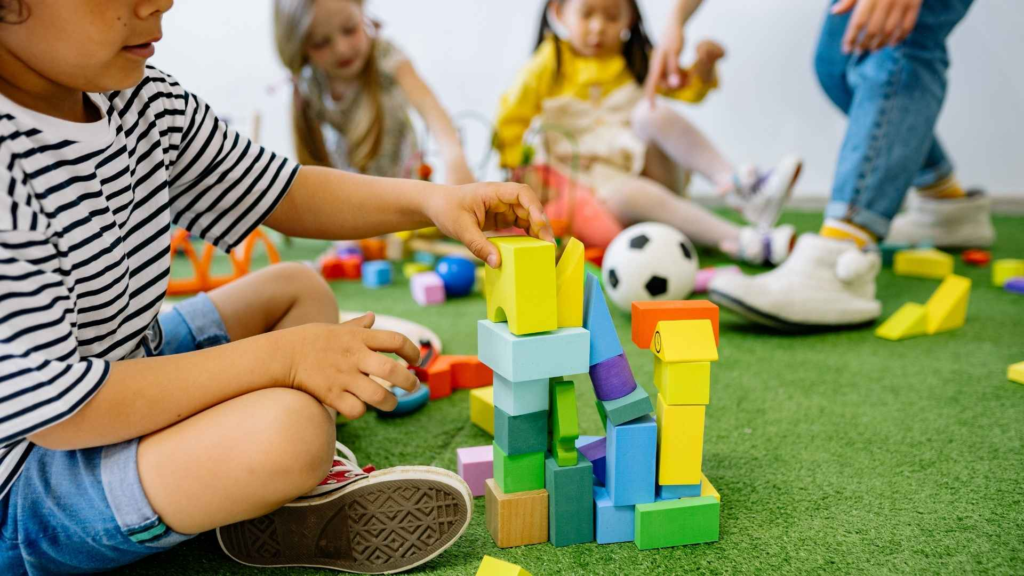
At a sensory table, toddlers learn to share scoops and molds. During block play, preschoolers negotiate who uses which pieces. These interactions teach patience and fairness in ways that matter to young children.
Using Words to Communicate
Instead of grabbing toys, children learn to say:
- “Can I have a turn when you’re done?”
- “Can I play too?”
- “I need help”
These verbal scripts replace physical actions and give children control over their interactions.
Listening and Following Directions
During circle time, children practice sitting, listening to the teacher, and waiting to speak. These skills directly prepare them for kindergarten classroom routines.
Handling Disappointment
Not every child can go first. Learning to wait, accept “no,” and manage frustration builds emotional resilience that serves children throughout life.
Recognizing and Expressing Emotions
Children learn to articulate feelings (“I feel mad” instead of throwing blocks) and notice when peers are sad or hurt. Offering comfort, a hug, getting a teacher, sharing a toy, develops empathy at an early age.
Group-Life Skills
Lining up for lunch, cleaning up after activities, waiting while the teacher helps another child, and participating in group songs without interrupting all teach children how society works.
In a typical Mary Margaret classroom, you might see a preschool group working together at a sensory table, negotiating who uses the water wheel, or a pre-K class collaborating on a building project that requires dividing blocks and roles.
The Role of Teachers: Quiet Guidance That Builds Confidence
Adults are essential to social learning. Children don’t automatically know how to share or negotiate, they learn these behaviors from what caregivers say and do in the moment.
Experienced daycare teachers model calm behavior, soft voices, and respectful language, especially during conflicts. When two children want the same toy, a skilled teacher might say: “Let’s use our words. You can say, ‘Can I have a turn when you’re done?’”
Teaching Through Scripts
Teachers provide children with verbal “scripts” they can use with peers:
- “I don’t like that” (instead of pushing)
- “Can I play too?” (instead of hovering awkwardly)
- “Let’s take turns” (instead of grabbing)
These phrases help children replace physical actions with clear, respectful communication.
Supporting Reserved Children
Trained caregivers watch for shy or anxious children and gently help them enter play. This might mean:
- Pairing them with one friendly peer
- Suggesting a shared activity like a puzzle
- Staying nearby during initial interactions
At Mary Margaret Daycare and Learning Center, nurturing the whole child, social, emotional, and academic, is central to our mission. Staff receive ongoing training to respond to children in consistent, encouraging ways across all nine locations.
Routines, Structure, and Emotional Safety
Children practice social skills more effectively when they feel safe, know what to expect, and trust the adults around them.
Predictable daily routines create a secure rhythm that lowers anxiety:
- Morning drop-off
- Breakfast or snack
- Circle time
- Learning centers
- Outdoor play
- Lunch
- Rest time
- Afternoon activities
When children know when it’s time to listen, move, talk, or rest, there are fewer power struggles. This creates more space to focus on cooperation and kindness with peers.
Practical Examples
A toddler group at a Mary Margaret center might use a simple picture schedule showing what happens next. Preschoolers sing a clean-up song that turns a potential conflict (“I don’t want to stop playing!”) into a cooperative group effort.
Consistent expectations across all nine Mary Margaret locations help children feel grounded. The same gentle reminders about “kind hands,” “listening ears,” and “walking feet” become familiar supports rather than surprises.
This routine creates emotional safety and emotional safety creates space for social growth.
Benefits of Early Social Skills for School and Life
Research from the American Psychological Association, tracking 979 families from 1991 to 2006, found that high-quality early childhood education programs significantly enhance social-emotional development. The benefits extend far beyond the daycare years.
Short-Term Benefits
Children who build strong social skills in the first five years tend to:
- Adjust more easily to kindergarten
- Build friendships with less anxiety
- Manage classroom expectations
- Cooperate with teachers
- Focus better in groups
- Experience fewer behavior issues
Long-Term Benefits
Early social competence at school entry is one of the top predictors of later outcomes. When children can wait, listen, and ask for help, they’re more available for learning reading, math, and problem solving skills.
The national center for research on early childhood has documented that social skills predict academic success because they free up cognitive resources. A child who isn’t struggling with peer conflicts can focus on the curriculum.
Special Value for Some Families
Daycare can be especially helpful for only children or those from small families who lack regular peer practice. The consistent exposure to age-mates accelerates skill-building that might otherwise happen much later.
Mary Margaret’s before- and after-school programs for children up to age twelve continue reinforcing social and self-management skills well beyond the preschool years, supporting public school success throughout elementary years.
Social Growth at Different Ages: From Infants to School-Age
Social development looks different at six weeks, eighteen months, four years, and ten years. Quality daycare centers adjust expectations and teaching accordingly.
Infants (Six Weeks to 12 Months)
For babies, social skills focus on building trust. The foundations include:
- Consistent, soothing responses to cries
- Eye contact during feeding
- Gentle talk during diaper changes
- Predictable routines that create security
These early interactions with adults lay the groundwork for all later relationships. According to Child Trends, 7% of parents with toddlers or infants use paid childcare and for those families, quality infant care matters enormously.
Toddlers (1-3 Years)
Toddlers engage in parallel play playing near other children rather than directly with them. Early peer interactions include:
- First attempts at sharing with adult support
- Learning simple words like “mine,” “more,” and “help”
- Beginning to control impulses (using words instead of biting or pushing)
This is when teaching children to speak their needs rather than act them out becomes critical.
Preschool and Pre-K (3-5 Years)
Preschoolers handle more complex social tasks:
- Playing “house” with assigned roles
- Solving disagreements with teacher coaching
- Understanding basic rules in simple games
- Practicing empathy when friends are upset
This age group benefits enormously from the structured interactions that daycare provides.
School-Age Children (5-12 Years)
Before- and after-school programs support older children through:
- Homework clubs with peer collaboration
- Group projects requiring teamwork
- Team games that develop leadership
- Practice respecting rules and community members
Mary Margaret’s programs for school-age children continue building these skills during the hours before and after public school, plus fun-filled summer programs with field trips.
How Mary Margaret Daycare and Learning Center Supports Social Skills in St. Louis
For parents in the St. Louis Metropolitan area who want both safety and meaningful growth for their children, finding the right daycare matters deeply.
Mary Margaret Daycare and Learning Center has served families since 1988. Today, we offer nine convenient locations across the St. Louis region, all providing care for children from six weeks to twelve years old.
Our Approach
Our core promise “Fun balanced with education” means social skills are woven into everything we do:
- Daily play and learning centers
- Field trips that build cooperation
- Enrichment activities
- Structured group interactions
Why Parents Trust Us
Since 1988, we’ve dedicated ourselves to fostering education while building self-esteem in a secure environment with opportunities for fun and play. We offer before and after school care, plus summer programs that keep children engaged and growing socially.
We invite you to contact a nearby Mary Margaret location to schedule a tour. Observe classroom routines, ask how teachers handle conflicts, and see firsthand how children practice communication, cooperation, and confidence every day.
FAQ: Parents’ Common Questions About Daycare and Social Skills
At what age can daycare start helping my child build social skills?
Even young infants as early as six weeks begin social development through bonding with caregivers, eye contact, and responsive care. These early interactions build the trust that underlies all later relationships. Peer-based skills like sharing and taking turns typically emerge between 18 months and three years as children develop language and impulse control.
Mary Margaret centers tailor interactions to each age group. Babies receive consistent, nurturing care that builds attachment security. Toddlers get gentle support for early peer play. Preschoolers and school-age children engage in increasingly complex social activities appropriate to their developmental stage.
How can I tell if a daycare is really supporting my child’s social growth?
Look for these signs during a tour:
- Teachers on the floor, actively engaged with children
- Respectful language used during conflicts
- Children playing together rather than wandering aimlessly
- Clear routines that children seem to understand
Ask specific questions like:
- “How do you handle biting or hitting?”
- “How do you help shy children join in?”
- “How do you teach children to use words instead of grabbing?”
Quality programs will have thoughtful answers that emphasize guidance over punishment and skill-building over simple behavior management.
What if my child is very shy or has trouble making friends?
Many children start daycare shy, this is completely normal. A consistent, patient environment with gentle teacher support and small-group activities can gradually build confidence over weeks and months.
Mary Margaret staff work closely with families to understand each child’s temperament. We share strategies that work at school so parents can reinforce them at home. Often, pairing a shy child with one friendly peer or suggesting low-pressure activities like puzzles helps them ease into group play at their own pace.
Will being around many children make my child pick up bad behaviors?
Children do copy both positive and negative behaviors from peers. However, in a well-managed daycare, caregivers quickly redirect hurtful actions and consistently reinforce kind, cooperative behavior.
Over time, children adopt the prosocial norms that teachers and peers model—saying “please,” waiting for a turn, helping a friend who’s upset. The importance of skilled adult supervision cannot be overstated: proactive redirection ensures that positive behaviors become the classroom culture.
How can I support my child’s social skills at home while they attend daycare?
Simple at-home practices reinforce what children learn in daycare:
- Play turn-taking games (board games, card games, even rolling a ball back and forth)
- Model calm talk during disagreements between adults or siblings
- Read books about feelings and discuss characters’ emotions
- Ask specific questions about their day: “Who did you play with today?” or “How did you solve that problem?”
Quality daycare does more than watch children, it actively shapes their ability to connect, communicate, and cooperate with others. The social skills your child builds during these early years become the foundation for friendships, school success, and lifelong confidence.
For St. Louis families seeking trusted early childhood education that balances fun with meaningful development, Mary Margaret Daycare and Learning Center has been the choice since 1988. Contact one of our nine locations today to schedule a tour and see how we support the whole child, social, emotional, and academic, every single day.